A full set of intelligent mattress machinery industry brands
Mattress machines are exported to 150+ countries
Date:2026-08-28
In the mattress manufacturing industry, the pocket spring system is the core component that determines comfort, support, and durability. With the continuous evolution of ergonomics and materials science, shaped pocket springs are becoming a key differentiator for mattress products, thanks to their unique geometric designs and precise mechanical properties. This article starts with the basic concepts of shaped pocket springs and systematically analyzes the technical characteristics and application scenarios of mainstream types including herringbone, olive, tower, skirt, hourglass, dumbbell, stranded wire, galvanized, micro spring (bubble spring), and high-compression springs, while providing a professional selection framework.

Shaped springs refer to elastic components whose shape, structure, or mechanical characteristics differ from standard cylindrical coil springs. Their core value lies in adapting to scenarios with limited space or uneven force distribution. Compared with general-purpose springs, shaped springs are more like "customized solutions" – standard springs meet general elastic requirements, while shaped springs specifically solve "special challenges," such as mattress support layers that need to precisely conform to the human body's curves, or independent pocket systems that require noise-free, anti-interference performance.
It is worth noting that the category of shaped springs is not limited to mattress interiors. In furniture manufacturing, S-springs (also known as serpentine or wave springs) are typical shaped extension springs, made by continuously bending steel wire into an S-wave pattern, widely used for elastic support in sofa seats, soft bed seats, and backrests. Z-springs are continuous zigzag or sawtooth shapes, divided into flat steel serpentine Z-springs (lateral force, suitable for large-area support) and round wire Z-springs (compound force, suitable for precision small spaces), with applications in furniture, automotive, and precision electronics.
This article focuses on springs for mattress use, namely shaped coil springs in pocket spring systems. These springs exist in independent pocket form, with each spring enclosed in a fabric pocket, connected into a unit through ultrasonic welding or adhesive bonding, achieving point-to-point precise support and excellent anti-interference performance.
Standard pocket springs use vertical welding, resulting in narrow gaps between adjacent springs that cannot accommodate the folding angles of adjustable bed bases, often causing obvious bulging, localized collapse, and spring displacement under pressure. To overcome this issue, Lianrou uses a special herringbone welding method, where each spring has a certain inclination angle and the spring itself is bent. Adjacent springs do not rub or squeeze against each other, and can flexibly follow any bending angle of the adjustable bed base without distortion. At the same time, the built-in ample buffer space distributes pressure evenly and disperses force, achieving zero breakage and zero bulging under repeated high-frequency bending. Furthermore, the spring inclination angle and load-bearing force of the herringbone spring have been rigorously calculated and subjected to fatigue testing, giving the spring core lasting durability.
The olive spring has a diameter design that decreases at both ends and increases in the middle, resembling a barrel. Its mechanical characteristic is that pressure is concentrated at both ends of the spring, effectively reducing mutual interference between springs, minimizing sway, and providing stable support.
Structurally, the olive-shaped spring has smaller diameters at both ends, and the gaps between adjacent springs form a V-shape, making the unit easy to bend and fold, perfectly matching the bending angles of adjustable bed bases. Therefore, the olive-shaped spring is the preferred choice for adjustable bed spring cores. For manufacturers producing smart adjustable mattresses, this feature offers irreplaceable value.
The tower spring also uses a geometric design with small ends and a large middle, but typically has more than 11 coils, significantly more than the olive-shaped spring. The multi-coil structure provides three major advantages: high load capacity, high stiffness, and strong shock absorption.
The tower-shaped spring has a small contact area at both ends, so the springs do not collide with each other when loaded, resulting in outstanding anti-interference performance. Combined with its excellent shock absorption, the tower-shaped spring is ideally suited for noise-reducing comfort mattresses, especially for user groups with high demands for a quiet sleep environment.
The skirt-shaped spring has a diameter variation pattern opposite to that of the olive-shaped spring, with large ends and a small middle in a decreasing-then-increasing design, and the top coil has a slightly smaller diameter, resembling a skirt. Its support force along the spring's axial direction follows a strong-to-weak-to-strong curve.
The smaller diameter in the middle allows strong support force to be smoothly dispersed to the bottom, achieving graduated pressure relief. This design helps reduce sleep disturbances during position changes, making it suitable for mattress products that pursue deep sleep experiences.
The hourglass-shaped spring's biggest feature is its built-in comfort layer function. Its diameter distribution is large at both ends and small in the middle, with typically 10.5 or more coils. The small waist diameter in the middle with dense coils provides strong support, while the large diameters at both ends deliver a slow-rebound, soft-support feel.
This combination of "strong support + soft landing" enables the hourglass-shaped spring to adaptively support body curves with high conformity. It can achieve a good wrapping feel without the need for additional foam or latex comfort layers, simplifying the mattress structure while ensuring excellent sleep quality.
The dumbbell spring lives up to its name, with a small waist diameter in the middle and large diameters at both ends, with a significant diameter difference. During loading, the upper and lower ends form "buffer zones" that gently transfer pressure to the middle area, achieving gentle, slow-rebound support.
The dumbbell spring typically has more than 10 coils, extending the compression and rebound stroke and providing a longer-lasting cushioning experience. Its sleep feel can be summarized as "latex-like softness" and "foam-like body-conforming wrap," making it especially suitable for soft mattresses to meet the needs of consumers who prefer a plush sleep feel.
The stranded wire spring achieves a breakthrough at the material level, using wire formed by spirally twisting multiple metal strands instead of traditional single wire. This torsion structure draws on high-strength application experience from the automotive, machinery, and construction industries, endowing the spring with multiple performance advantages:
Stranded wire springs are suitable for positioning high-end, durable mattresses, especially for product lines with strict requirements for spring life and fatigue resistance.
The core breakthrough of the galvanized spring lies in its corrosion resistance. Pocket springs on the market generally use high-carbon steel wire, which, although more corrosion-resistant than iron, will oxidize and rust when exposed to humid air and moisture for extended periods. Rust gradually weakens the spring's elasticity and affects the mattress's service life.
Galvanized steel wire has the characteristic of never rusting, maintaining its bright metallic luster over time. Paired with cotton-linen fabric pockets – a high-quality pocket material that is moisture-absorbent, breathable, skin-friendly, and durable – galvanized pocket springs are often used in handcrafted mattresses, eco-friendly mattresses, and high-end mattresses. For brands in humid climates or with extremely high requirements for product durability, galvanized springs are a solution worth prioritizing.
The micro spring, also known as a bubble spring, mini spring, or nano spring, is an ultra-small independently pocketed spring, typically used as a comfort layer or transition layer in mattresses, positioned between the main spring core and the fabric, with a layer height of only 2–5 cm. It solves the problems of traditional foam or latex comfort layers – such as susceptibility to sagging, poor breathability, and motion transfer – and represents a revolutionary alternative for comfort layer materials.
The core value of the micro spring is reflected in:
The high-compression micro spring uses high-compression technology, enabling the micro spring to store more elastic potential energy within the same volume. Tests have proven that under the same wire diameter and compression amount, its support force is significantly better than that of ordinary micro springs, with stronger resistance to sagging.
Its main advantages include:
Each pocket spring is both a support point and a pressure relief point. The more support points, the better the mattress's precision support effect. To this end, we have introduced a high-density pocket spring unit for spinal protection and lumbar support, named the Supermicro Pocket Spring Unit. The mini spring's waist diameter can be as small as 30mm, with wire diameters typically 1.0mm/1.1mm/1.2mm. The reduced waist-to-hip ratio concentrates the support force, providing high firmness and high elasticity. A mattress contains approximately 3,000–4,000 mini springs arranged in a dot matrix, creating a dense array of support points, as if there were thousands of massage points that precisely support every part of the body, leaving no area unsupported – especially providing stronger support to the waist, hips, and legs. With dense and uniform force distribution, the entire body is supported throughout the night, delivering exceptional comfort. It is suitable for manufacturing corrective, spinal-protecting, lumbar-supporting mattresses and high-comfort premium mattresses.
Compared with traditional mattresses using ordinary springs, whether stacked in two or multiple layers, they are all planar without functional differentiation, providing undifferentiated support to physiologically varied areas such as shoulders, back, waist, and hips, often resulting in localized muscle soreness or lumbar discomfort upon waking. The Curved Double-Deck Pocket Spring solves this problem, achieving truly precise zoned support customized for each individual. The springs are configured in high and low soft-firm curved zones based on the physiological weight distribution of different body areas, perfectly matching individual body contours. Using a double-layer curved zoned structure, the upper comfort layer uses thinner wire diameter springs, while the lower support layer uses thicker wire diameter springs. Springs with more coils are taller and softer, while those with fewer coils are shorter and firmer. For example, in the high-pressure hip area, the upper layer's taller, softer springs conform to the body curve, creating greater deformation to envelop the body, while the lower layer's shorter springs provide enhanced support and a stable foundation. For lighter areas such as the feet, taller springs are used to reduce support force and enhance soft wrapping comfort.
This design, which achieves gradually differentiated mattress support force through coil count and spring height, has the greatest benefit of maintaining the spine in a natural straight line for healthy sleep, allowing organs, blood circulation, and the spine to each find their proper place. It also has corrective effects, extends deep sleep time, and reduces the number of position changes. Whether for patients with spinal conditions or fitness enthusiasts, everyone can find the most suitable support level.
One-person-one-mattress production process: By collecting human body pressure values through pressure sensors, the system automatically generates zoned curve data representing the weight distribution of different body parts. The Curved Double-Deck Pocket Spring Machine can then produce a pocket spring unit that perfectly matches an individual's sleep pressure values for different organs and body parts.
The Wave-Shaped Pocket Spring Unit is an innovative shaped spring structure, with the overall unit presenting a wave-like form composed of peaks and valleys connected vertically. Each spring has the same diameter, but the height is set according to the pressure requirements of different body parts. For example, shorter springs with fewer coils provide stronger support to maintain the natural growth curve of the spine and skeletal structure, and are placed in the lumbar area; while taller springs with more coils provide weaker support but greater flexibility and comfort, and are placed in the foot area. This structure endows the pocket spring unit with excellent mechanical properties, achieving precise support, softness, cushioning, and comfort in mattress applications, while also offering the advantages of light weight and material savings, helping to reduce manufacturing costs.
For conventional springs, the only way to increase support is to use thicker steel wire. But thicker wire means higher material costs, a heavier unit, and increased transportation costs. Lianrou's ultra-high spring pre-compression technology solves this problem, with spring pre-compression exceeding 100%, allowing the spring to store more elastic potential energy and achieve stronger rebound. Using the same wire diameter, the support force of a high-compression pocket spring far exceeds that of a conventional spring. A high-compression pocket spring with a 1.7mm wire diameter is equivalent to a conventional pocket spring with a 1.9mm wire diameter, saving 19.5 RMB per unit. High-compression pocket springs achieve the same firmness with less steel wire cost, delivering cost reduction without compromising quality.
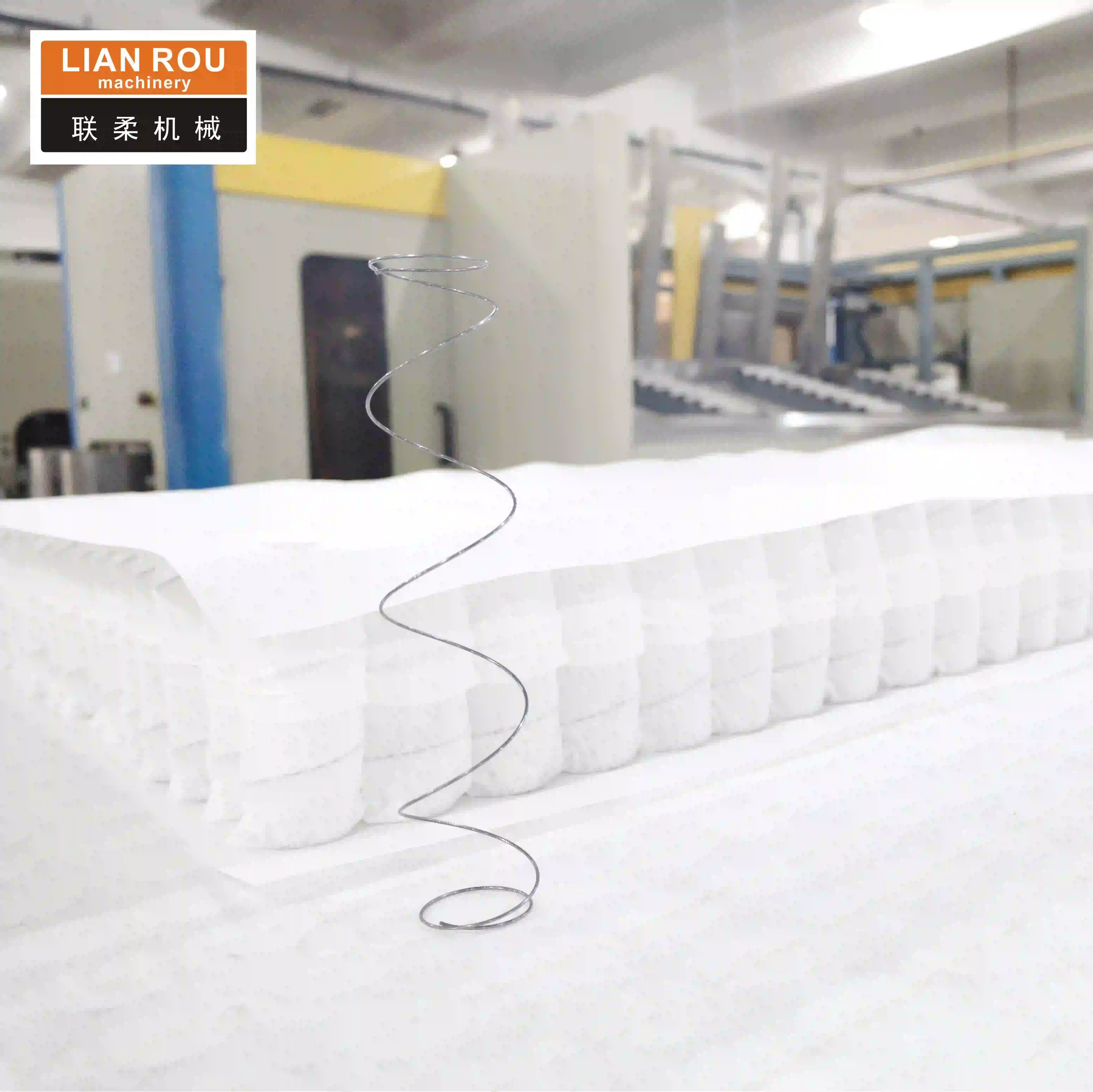
Traditional pocket spring units commonly use non-woven fabric + ultrasonic welding, where the fabric and steel wire spring are tightly bonded and cannot be effectively separated. Lianrou Machinery uses sewing technology instead of ultrasonic welding to seal the pockets, allowing the spring to be completely separated from the fabric by simply pulling the sewing thread, without any chemical adhesive or specialized equipment – anyone can do it at home.
In the production of hybrid mattresses, there is often a significant amount of foam, latex, and other edge trimmings. How can these comfort layer waste materials be efficiently reused and turned into valuable mattress components? From an environmental perspective of waste utilization, Lianrou introduces the Pocket Spring with Foam (Cloud Foam Pocket Spring Unit), which fills the non-woven pockets with shredded foam, shredded latex, stuffed cotton, and other materials. This creates a pocket spring composite comfort layer that reduces or eliminates the need for additional comfort layer processes, achieving high mattress comfort while simplifying production. Only an outer mattress cover needs to be added to complete the finished mattress, significantly saving production costs, and it is especially suitable for adjustable beds.
Almost all irregularly shaped springs can be produced using a fully ultrasonic welding process, creating pocket spring mattresses that require no glue. Glue-free pocket spring mattresses, using a fully ultrasonic welding process, have four adjacent springs forming a cloverleaf structure, offering advantages such as even support, strong tear resistance, and a strong sense of unity within the mattress. This makes them suitable for producing environmentally friendly glue-free mattresses, handmade mattresses, and fully disassembled mattresses.
Spring Type | Core Advantages | Typical Application Scenarios |
V-shaped Pocket Spring | Easy to bend and folding, adapt to different folding angles | Electric Folding Bed, Smart Bed |
Olive-Shaped Pocket Spring | Easy to bend and fold, compatible with adjustable bed bases | Adjustable bed, cotton-linen pocket springs |
Tower-Shaped Pocket Spring | High load capacity, shock absorption and noise reduction | Noise-reducing comfort mattresses |
Skirt-Shaped Pocket Spring | Graduated pressure relief, stable support | Deep sleep mattresses |
Hourglass-Shaped Pocket Spring | Built-in comfort layer, high conformity | Adaptive support mattresses |
Dumbbell Spring | Slow rebound, zero-pressure feel | Soft mattresses |
Mulit-stranded Wire Pocket Spring | High elasticity, high load capacity, durable | High-end durable mattresses |
Galvanized Pocket Spring | Springs never rust, ultra-long lifespan | High-end eco-friendly handcrafted mattresses |
Micro Spring / Bubble Spring | Comfort layer revolution, ultimate conformity | Mattress comfort layer, replacing foam/latex |
High-Compression Pocket Spring | High support, low cost, lightweight | Roll-pack mattresses for cross-border e-commerce |
曲线双层袋装弹簧床网 | 根据个体压力值制作,精准科学分区支撑 | 追求一人一垫定制化需求 |
Curved Double Layers Pocket Spring Unit | Produced based on individual pressure data, precise scientific zoned support | Customized one-person-one-mattress solutions |
Wave-Shaped Pocket Spring | High strength and toughness, lightweight and material-saving | Mattresses combining support and cushioning |
Pocket Spring with Foam / Cloud Foam Pocket Spring Unit | High comfort, simplified processes, cost savings | Adjustable beds |
Supermicro Pocket Spring | Dense force points, high firmness, high elasticity | Suitable for firm mattresses, high-quality premium mattresses, spinal-protecting corrective mattresses |
Eco-Friendly One-Thread Detachable Pocket Spring Unit | Mechanical sewing replaces ultrasonic welding for pocket sealing; simply cut the thread and pull to separate spring from pocket | Complex end-of-life mattress disposal policies in Europe and the US; increasing detachable pocket spring mattress offerings enhances brand value-added services |
The selection of shaped pocket springs requires comprehensive consideration from multiple dimensions, including product positioning, target customer groups, cost control, and compliance requirements.
1. Define mattress positioning and target sleep feel
2. Focus on core performance parameters
3. Evaluate cost-effectiveness
4. Consider environmental and safety compliance
In the actual procurement process, the following points deserve special attention:
1. Do not judge spring quality based solely on surface feel: As consumer council tests have shown, mattress price does not necessarily correlate with quality—some high-priced products actually perform poorly in lateral support. Suppliers should be required to provide material certificates, dimensional inspection reports, and fatigue test data.
2. Beware of the misconception that "soft is good": A truly high-quality mattress should feature "surface-level body-conforming pressure relief combined with strong underlying support without sagging." A hollow lower back or excessive sagging can lead to spinal issues. The choice of shaped springs should serve the precise needs of ergonomics.
3. Pay attention to production equipment and process capability: A good shaped spring manufacturer should be equipped with modern camless machines (servo motor controlled), with short setup times, high precision, and feeding repeat positioning accuracy up to ±0.003mm. Equipment capability directly determines batch-to-batch consistency and quality stability.
4. Adhere to the principle of structural simplification: Shaped spring design should not blindly pursue complexity. Reasonable structural simplification does not compromise performance and can significantly improve production yield rates while reducing manufacturing costs.
The selection of shaped pocket springs is a systematic process. A deep understanding of each spring type's unique performance characteristics and applicable boundaries is the key to creating differentiated mattress products with market competitiveness. It is hoped that this article provides valuable professional reference for mattress manufacturers and procurement decision-makers.
Shaped pocket springs are elastic components whose shape, structure, or mechanical characteristics differ from standard cylindrical coil springs. Each spring is individually encased in a fabric pocket, and these pockets are connected to form the support core of a mattress. Unlike standard springs that meet general elastic requirements, shaped pocket springs are "customized solutions" designed for specific challenges—such as precisely conforming to human body curves, accommodating adjustable bed folding angles, or providing noise-free, anti-interference performance.
The key difference lies in both geometry and connectivity. Ordinary spring systems (like Bonnell springs) are interconnected—when one spring moves, it pulls on neighboring springs, causing motion transfer across the entire mattress surface. Shaped pocket springs, on the other hand, are individually wrapped and move independently. Each spring responds only to pressure in its own area, which significantly limits how much movement travels across the mattress. Furthermore, shaped pocket springs feature specialized geometric designs (olive, tower, hourglass, dumbbell, etc.) that provide tailored support characteristics—from zero-pressure sleep feel to graduated pressure relief.
For adjustable bed bases, the Olive-Shaped (Barrel-Shaped) Pocket Spring and the Herringbone Pocket Spring are the top choices. Olive-shaped springs have smaller diameters at both ends with V-shaped gaps between adjacent springs, making the unit easy to bend and fold to match the folding angles of adjustable bed frames. Herringbone pocket springs use a special welding method where each spring has a certain inclination angle and is bent, allowing them to flexibly follow any bending angle without bulging, breakage, or spring displacement.
While both feature variable diameters, their design objectives differ:
Dumbbell springs have a small waist diameter in the middle with significantly larger diameters at both ends. During loading, the upper and lower ends form "buffer zones" that gently transfer pressure to the middle, achieving gentle, slow-rebound support. With more than 10 coils, they extend the compression and rebound stroke for longer-lasting cushioning. The sleep feel is often described as "latex-like softness" and "foam-like body-conforming wrap," making them especially suitable for soft mattresses catering to consumers who prefer a plush sleep feel.
Galvanized pocket springs offer a core breakthrough in corrosion resistance. Standard high-carbon steel springs will oxidize and rust when exposed to humid air and moisture over time, gradually weakening elasticity and affecting mattress lifespan. Galvanized steel wire has the characteristic of never rusting, maintaining its bright metallic luster over time. When paired with cotton-linen fabric pockets—which are moisture-absorbent, breathable, skin-friendly, and durable—galvanized pocket springs are ideal for handcrafted mattresses, eco-friendly mattresses, and high-end mattresses, especially for humid climates or brands with high durability requirements.
Micro springs, also known as bubble springs, mini springs, or nano springs, are ultra-small independently pocketed springs used as a comfort layer or transition layer in mattresses, positioned between the main spring core and the fabric, with a layer height of only 2–5 cm. They solve the problems of traditional foam or latex comfort layers—such as susceptibility to sagging, poor breathability, and motion transfer. Each micro spring independently responds to pressure from different body parts, precisely supporting body curves while maintaining excellent breathability and durability far superior to foam.
High-compression pocket springs use ultra-high spring pre-compression technology with pre-compression exceeding 100%, allowing the spring to store more elastic potential energy. Using the same wire diameter, their support force far exceeds that of conventional springs. For example, a high-compression spring with 1.7mm wire diameter is equivalent to a conventional spring with 1.9mm wire diameter, saving approximately 19.5 RMB per unit. This delivers cost reduction without compromising quality, making them particularly suitable for cross-border e-commerce roll-pack mattresses where lightweight and shipping cost savings are critical.
Selection should be based on product positioning and target sleep feel:
Also consider core performance parameters: material (galvanized or stainless steel in humid environments), dimensional tolerance (within ±0.05mm), fatigue life (10⁶+ cycles), and stiffness coefficient.
Avoid these common pitfalls:


TOP
