A full set of intelligent mattress machinery industry brands
Mattress machines are exported to 150+ countries
Date:2026-08-27
If you are planning to set up a pocket spring factory, furniture spring factory, or mattress spring production line, the most important decision is not simply which pocket spring machine to buy. You need to choose the right spring products for your target market, calculate production capacity before purchasing machinery, design the material flow and factory layout, select the right pocket spring assembly machine, and plan compression and rolling equipment for shipping. A wrong decision at any of these stages can lock up capital, create bottlenecks, increase labor costs, or leave you with machinery that cannot match your customers' actual spring requirements. For mattress manufacturers, sofa manufacturers, pillow factories, and furniture producers, the most flexible starting point is usually a standard pocket spring production line that can later expand into high-compression pocket coils, sofa pocket springs, micro springs, zoned spring units, glue-free spring units, or other specialized furniture springs. The right factory model should therefore be designed backward from your customers' products, daily output, wire specifications, spring dimensions, packaging requirements, and target countries—not simply from the machine's maximum speed.
A successful pocket spring factory is essentially a coordinated system of spring design, steel-wire processing, fabric forming, pocket spring production, spring unit assembly, quality control, compression, packaging, and logistics. Buying one fast pocket spring machine does not automatically create a profitable factory. The production line must be balanced so that the output of the pocket coil machine matches the capacity of the pocket spring assembly machine and the downstream rolling or compressing machine.
For a new factory, standard cylindrical or barrel-shaped pocket springs are generally the easiest products to commercialize because they can serve mattress and upholstered furniture applications. A more flexible investment strategy is to choose multifunctional equipment capable of producing standard pocket springs together with high-compression springs, four-loop springs, or sofa springs. According to the supplied factory guide, LianRou's LR-PS-UMS/UMD multifunctional pocket spring machine is designed around this type of flexibility.
Production capacity must be calculated from actual mattress demand rather than a machine's advertised maximum speed. The source guide gives an example in which an 180-springs-per-minute machine can produce approximately 86,400 springs during an eight-hour theoretical shift, while the practical number of mattress spring units depends on spring count, uptime, changeovers, product specifications, and assembly capacity.
For export-oriented factories, compression and rolling are not optional afterthoughts. Uncompressed spring units occupy substantial container volume. The supplied guide estimates that compressed spring units can reduce transportation volume by approximately 60–80%, although the actual result depends on spring-unit design and compression ratio.
The best factory is therefore not necessarily the one with the fastest machine. It is the factory whose pocket spring machine, pocket spring assembly machine, product portfolio, manpower, factory layout, quality system, and logistics process are correctly matched to its customers.
The first question for a mattress or furniture manufacturer is whether producing a spring unit internally will actually improve the economics of the business. Buying finished pocket spring units is simple, but it also means accepting a supplier's price, delivery schedule, minimum order quantity, product specifications, and quality consistency. When spring units represent a significant portion of your mattress or upholstered furniture bill of materials, moving upstream can give you greater control over both cost and product development.
Pocket springs are particularly attractive because individual coils are enclosed in fabric pockets and can work relatively independently. Recent market research describes pocket spring mattresses as offering point-elastic support, reduced motion transfer, contouring, and opportunities for zoned support. Current market estimates differ depending on whether researchers measure pocket spring mattresses, individually pocketed spring mattresses, or the narrower independent pocket spring component market. For example, one 2026 market study projects the global pocket spring mattress market to grow from approximately US$6.1 billion in 2025 to US$9.9 billion in 2032, while another estimates the individually pocketed spring mattress market at approximately US$8.6 billion in 2025. These differences demonstrate why factory investment should be based on your target product and geography rather than one headline market number.
For mattress factories, internal production can also shorten the product-development cycle. Instead of asking a supplier to modify a pocket coil, you can test different wire diameters, coil heights, spring counts, zoning patterns, compression ratios, and fabric configurations directly on your production line. For furniture manufacturers, the same principle applies to sofa seats, upholstered chairs, cushions, and other applications where spring geometry and firmness need to be customized.
The economic decision should therefore be evaluated using five numbers: monthly spring-unit demand, current purchase price, internal material cost, expected labor and electricity cost, and machine utilization. If demand is too low, outsourcing may remain more economical. If demand is stable and high enough to keep machinery productive, setting up your own pocket spring factory becomes much more attractive.
Not every spring product requires the same machine configuration, and choosing the wrong product at the beginning is one of the easiest ways to over-invest in a new factory. Your first spring should be selected according to the customers you already have—or the market you can realistically reach—not simply according to which spring looks technologically advanced.
Standard pocket springs are usually the logical starting point for a mattress-focused factory because they can be used across a broad range of mattress designs. The supplied technical guide identifies standard cylindrical and barrel-shaped pocket springs as common products, with typical wire diameters in the approximate range of 1.6–2.3 mm and spring counts varying according to mattress size and design.
If your business focuses on bed-in-a-box mattresses and export markets, high-compression pocket springs may deserve priority. The supplied guide describes LianRou's LR-PS-UMS/UMD Pocket Spring Machine as a multifunctional machine capable of producing high-compression pocket springs as well as standard springs, four-loop springs, and conventional sofa springs. The guide further states that its high-compression spring technology can use approximately 1.7 mm wire to achieve a support level comparable in testing to a conventional 1.9 mm spring, potentially reducing material usage and shipping weight. These are manufacturer-supplied technical claims and should be validated through your own load, fatigue, and dimensional testing before being used as a customer specification.
Furniture manufacturers have additional opportunities. Short pocket springs can be produced for sofa cushions and upholstered seating, while micro springs can be used as comfort-layer components in mattresses, sofas, automotive seats, and specialized cushions. The supplied guide gives the LR-PSLINE-BOX230/BOX4W box pocket spring production line as an example, with a stated production rate of up to 230 micro springs per minute, approximately 1.0–1.5 mm wire diameter, and spring heights of approximately 18–37 mm.
The best first product is therefore usually the one that gives you the broadest customer coverage while keeping the machine configuration flexible enough for your next product.
A pocket spring factory and a Bonnell spring factory are not simply two versions of the same production line. Their spring geometry, forming process, assembly method, equipment, and target markets are different. This distinction matters when planning a furniture spring factory because buying the wrong machinery can make your entire investment unsuitable for the intended product.
A Bonnell spring is traditionally formed into a connected hourglass structure and assembled into a continuous spring network. It is relatively simple, economical, and suitable for price-sensitive mattress and furniture markets. The supplied guide identifies Latin America, Africa, and some Asian markets as important applications for lower-cost Bonnell spring products. Standard Bonnell springs may use approximately 1.8–2.4 mm wire, while heavy-duty versions can use larger wire sizes for higher-load applications.
A pocket spring, by contrast, consists of individually enclosed coils. The independent structure allows manufacturers to develop different spring counts, firmness zones, coil geometries, and comfort characteristics. This makes pocket coils particularly useful for premium mattresses and upholstered furniture where motion isolation, point support, and customization are important. Recent market research also identifies mattresses and upholstered furniture as major application areas for individually pocketed springs.
The machinery is also different. A pocket spring production line requires coil forming, fabric pocket formation, spring insertion and sealing, followed by spring-unit assembly. Bonnell production involves forming the hourglass spring and mechanically assembling the springs with helical wires and edge reinforcement. The source document explicitly states that the two systems are not interchangeable.
If your goal is premium mattress manufacturing or export-oriented furniture production, pocket spring technology generally provides more product-development opportunities. If your market is dominated by price-sensitive mattresses, Bonnell may remain commercially relevant. Some factories can strategically operate both systems to serve different market segments.
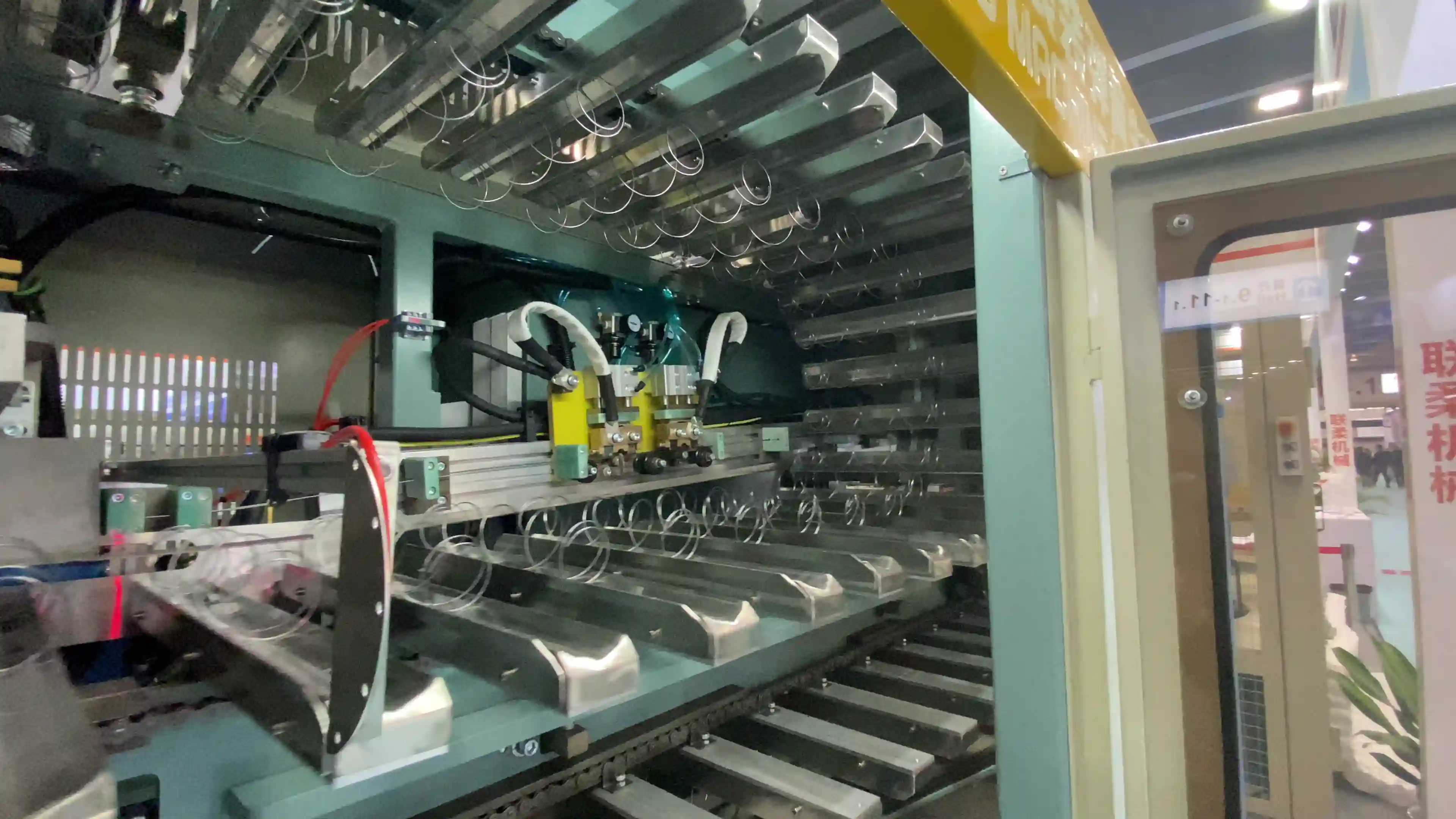
A complete pocket spring factory should be planned as a production system rather than a single machine purchase. At minimum, a conventional pocket spring production process includes a pocket spring machine, wire feeding system, spring cooling and conveying system, fabric forming and sealing system, pocket spring assembly machine, quality inspection equipment, and packaging or compression equipment.
The pocket spring machine forms steel wire into individual coils. According to the supplied technical guide, typical mattress and sofa pocket spring wire diameters fall around 1.6–2.3 mm, depending on the product. The guide also describes preheating before coiling as a method intended to release wire stress and improve dimensional consistency.
After forming, the springs must be cooled before entering the fabric pocket. The supplied equipment examples include O-shaped, U-shaped, and E-shaped cooling configurations. The LR-PS-EVD280 Pocket Spring Machine is specified in the source as reaching up to 280 springs per minute and using an E-shaped cooling structure. The same source states that the machine uses a chain-driven magnetic conveying system, with the maintenance advantage that damaged chain sections can be replaced individually rather than replacing an entire belt.
The next major machine is the pocket spring assembly machine. This equipment cuts and arranges the pocket spring strings and joins them into a complete spring unit. The source provides several configurations: LR-PSA-EX99 at approximately 27–30 rows per minute, LR-PSA-A1 at approximately 18 rows per minute, LR-PSA-97P at approximately 14–16 rows per minute, and LR-PSA-75P at approximately 5–6 rows per minute.
For export factories, add a rolling machine or compressing machine, because finished spring units must be prepared for efficient transportation. The equipment configuration should therefore be designed as a complete chain from raw steel wire to compressed spring unit.
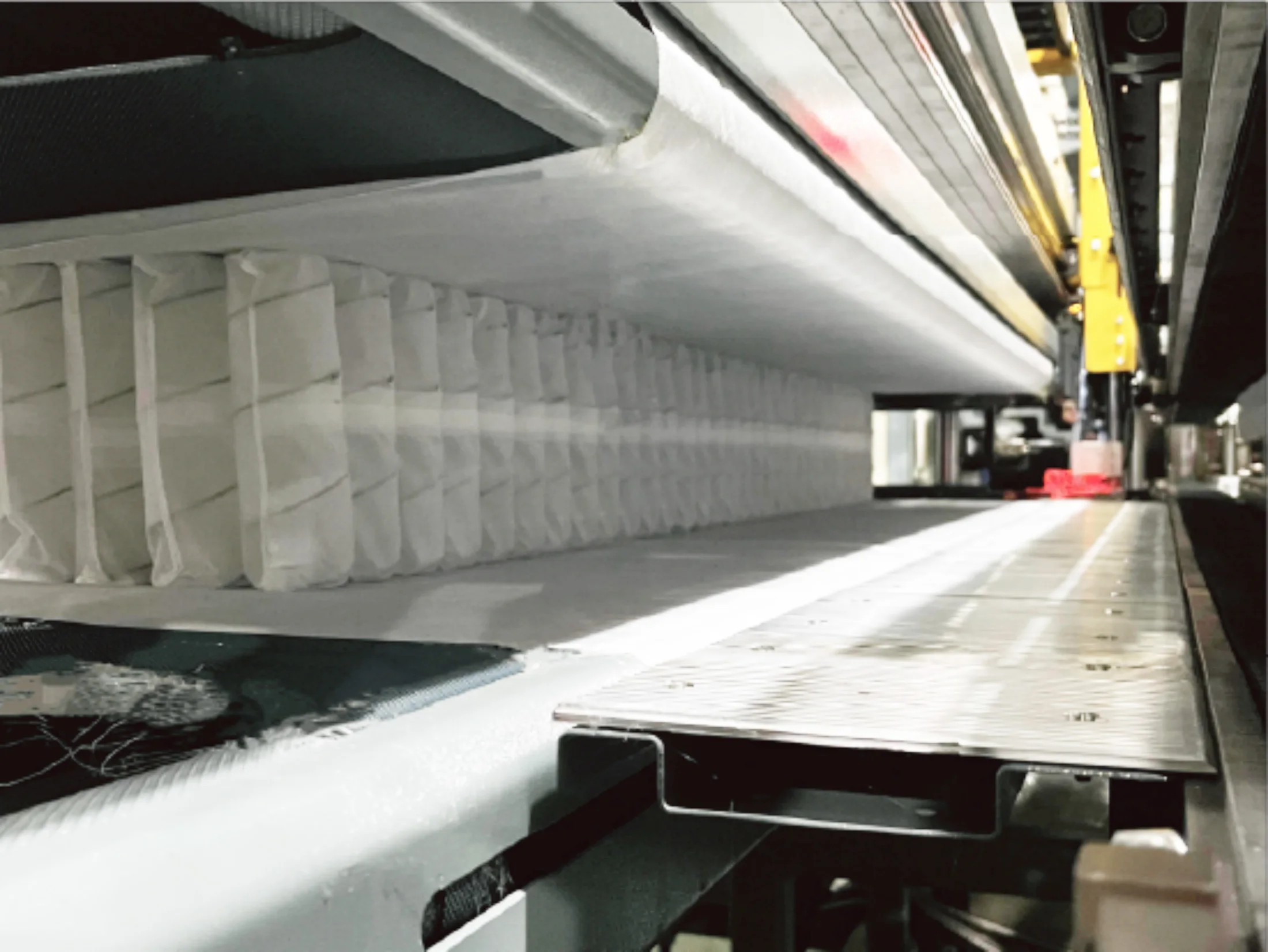
Understanding the production process is essential before purchasing a pocket spring machine because machine speed alone does not determine spring quality. The production process begins with steel wire feeding and coil forming, followed by controlled cooling, fabric pocket formation, spring insertion, sealing, and continuous pocket spring output.
First, high-carbon steel wire or another specified spring wire is fed into the forming system. The machine coils the wire into the required geometry. Spring diameter, height, number of turns, wire diameter, pitch, and end configuration all influence the final spring's load-bearing behavior. If the wire is not properly controlled during forming, dimensional variation can later create problems in fabric sealing, spring-unit assembly, or mattress consistency.
Second, the formed spring needs controlled cooling. The supplied guide emphasizes that the spring must be sufficiently cooled before entering the fabric pocket to prevent damage to the nonwoven material. This is particularly important when the factory operates at high speed because insufficient cooling can turn a seemingly productive machine into a quality bottleneck.
Third, the machine forms and seals the fabric pocket around individual coils. Ultrasonic welding is one common method. The source specifically describes swing-arm ultrasonic sealing as a method used for continuous pocket spring production at high speed.
Finally, the pocket spring strings enter the assembly stage. A pocket spring assembly machine cuts and arranges the strings into the required mattress or furniture spring-unit dimensions. This is where individual pocket coils become a commercially usable spring unit.
For manufacturers, this distinction is important: a pocket spring machine produces the individual pocketed coils or strings; a pocket spring assembly machine produces the finished spring unit.
Machine quantity should be calculated from actual spring demand rather than the machine's maximum theoretical speed. A useful planning formula is:
Required machines = Daily mattress demand × springs per mattress ÷ actual springs-per-minute output ÷ productive minutes per day
Suppose a mattress uses 800–1,000 pocket coils and the factory wants to produce 400 mattress spring units per day. That represents approximately 320,000–400,000 individual springs per day. The supplied factory guide uses an 180-springs-per-minute machine as an example and calculates a theoretical eight-hour output of approximately 86,400 springs per machine per shift. It then estimates that approximately four to five machines would be needed for the stated production target, depending on operating assumptions.
However, theoretical output is not the same as saleable output. A professional factory should account for setup time, wire changes, fabric changes, product changes, maintenance, operator breaks, quality inspection, rejected springs, and downstream assembly capacity. If the pocket spring machine produces faster than the assembly machine can consume the spring strings, the bottleneck simply moves downstream.
This is why manufacturers often discuss configurations such as one-to-one, two-to-one, and three-to-one. The source describes one-to-one as one pocket spring machine connected with one assembly machine, two-to-one as two spring machines feeding one assembly machine, and three-to-one as three spring machines feeding one assembly machine. For factories targeting approximately 200 mattress units per day, the source recommends considering three pocket spring machines and one assembly machine.
For purchasing decisions, do not ask a machine supplier only, “How many springs per minute?” Ask instead, “How many finished spring units can this complete line produce per shift using my exact spring specification?”
There is no universal “best” pocket spring production line because the correct configuration depends on output, product range, available labor, factory space, and market positioning. A small mattress manufacturer may need a flexible single-line setup, while an export-oriented industrial factory may benefit from multiple pocket spring machines feeding a high-speed assembly machine.
A one-to-one configuration is often appropriate for a factory entering the pocket spring market cautiously. One pocket spring machine feeds one pocket spring assembly machine. It provides a relatively straightforward production flow and allows operators to learn the process before expanding.
A two-to-one configuration increases spring production capacity while maintaining one assembly stage. It can be useful when the assembly machine still has enough capacity to consume the output from two spring machines.
A three-to-one configuration is designed for higher throughput. The source document identifies the three-to-one configuration as three pocket spring machines plus one pocket spring assembly machine and describes it as the fastest of the three configurations under comparable conditions.
For a new factory, however, expansion capability may be more important than maximum initial capacity. A practical approach is to build enough space, electrical infrastructure, material storage, and production flow for additional machines even if the factory initially installs only one or two pocket spring machines.
Multifunctional machinery can also reduce the need for separate production lines. For example, the source describes LR-PS-UMS/UMD Pocket Spring Machine as capable of switching between standard pocket springs, high-compression springs, four-loop springs, and conventional sofa springs. This kind of flexibility can be particularly valuable for a factory serving both mattress and furniture customers.
Factory size should be determined by the entire production workflow rather than the footprint of the pocket spring machine alone. You need space for raw-material storage, wire feeding, spring forming, cooling, pocket spring production, assembly, quality inspection, finished spring-unit storage, compression, packaging, and shipping.
The supplied guide estimates that a production line containing six machines—including spring forming, assembly, and rolling or packaging equipment—may require approximately 300–400 square meters. This should be treated as a planning reference rather than a universal requirement because actual machine dimensions, safety clearances, raw-material inventory, aisle widths, finished-goods inventory, and local regulations will change the required area.
A good pocket spring factory should follow a logical one-way material flow. Steel wire enters the raw-material warehouse, moves to the spring-forming area, passes through cooling and pocketing, reaches the assembly area, and then moves toward inspection, compression, packaging, and shipping. The goal is to minimize unnecessary backtracking.
Raw steel wire should be stored in a dry environment to reduce corrosion risk. Fabric materials should also be protected from excessive humidity. The pocket spring machine and assembly machine should ideally be positioned close together so that the spring strings can move efficiently between them without unnecessary manual handling.
For export factories, reserve additional space near the production-line end for a rolling machine, compressing machine, packaging area, and finished-goods staging area. This prevents shipping operations from interfering with spring production.
The right pocket spring machine should be evaluated through a technical specification matrix rather than a single speed number. Before purchasing, define your required wire diameter, spring height, spring diameter, number of turns, spring compression ratio, fabric type, production speed, product-change frequency, and target applications.
For mattress manufacturers, the machine should support the spring specifications required by your current and planned mattress portfolio. For sofa manufacturers, the machine should be capable of producing shorter pocket springs or other furniture-specific geometries. If your business plans to supply both mattresses and upholstered furniture, multifunctional equipment may deliver a better return than a machine optimized for only one spring type.
Speed is important, but stability at production speed is more important. A machine advertised at a high maximum speed may not provide the same practical output when producing complex spring geometries or operating continuously for multiple shifts. Ask the supplier to demonstrate your actual spring specification rather than a standard sample.
Cooling design, wire tension control, ultrasonic sealing, conveyor construction, servo control, PLC systems, changeover time, spare-parts availability, and remote technical support should all be included in the purchasing evaluation. The supplied guide specifically highlights E-shaped cooling on the LR-PS-EVD280 Ultra High Speed Pocket Spring Machine and identifies a stated maximum output of 280 springs per minute.
For international buyers, also ask about electrical standards, CE documentation where applicable, machine installation requirements, training, warranty terms, spare parts, remote troubleshooting, and the availability of engineers for commissioning.
A pocket spring production machine and a pocket spring assembly machine solve different problems, so they must be evaluated together. If the spring-forming section is much faster than the assembly section, unfinished spring strings will accumulate and working capital will be trapped in semi-finished inventory.
The assembly machine determines how quickly individual pocket spring strings can be transformed into a finished mattress spring unit. The supplied LianRou equipment examples illustrate different capacity levels. The LR-PSA-EX99 is specified at approximately 27–30 rows per minute with a double-row feeding structure. The LR-PSA-A1 is specified at approximately 18 rows per minute, while the LR-PSA-97P and LR-PSA-75P provide lower-speed configurations.
Your choice should depend on the dimensions and spring configuration of the finished unit. A machine that produces many rows per minute may not necessarily be the best option if your production mix includes frequent size changes, unusual zoning configurations, or customized furniture spring units.
The joining method also matters. Conventional pocket spring units may use hot-melt adhesive, while glue-free systems can use ultrasonic welding. The source identifies LR-PSA-GLL as a glue-free pocket spring unit production line using ultrasonic assembly technology.
For European and other environmentally conscious markets, glue-free spring-unit production can become a product-development advantage, but the factory should verify the required performance, durability, chemical, and product-compliance requirements for the destination market rather than assuming that “glue-free” alone makes a product compliant.
A modern pocket spring factory does not have to sell only one type of spring unit. Product diversification can allow the same production infrastructure to serve different mattress and furniture segments.
Standard pocket springs are usually the broadest starting point. They can be used in conventional mattresses and many upholstered furniture applications. They are relatively easy to explain to customers and provide a foundation for later product development.
High-compression pocket springs are particularly relevant to compressed mattress products and bed-in-a-box logistics. The supplied guide describes pre-compression above 100% and emphasizes the potential to achieve strong support with smaller wire diameters. The commercial benefit is not simply firmness; a lighter spring unit can potentially reduce shipping weight and material consumption when the design is properly engineered.
Micro springs serve a different purpose. The supplied LR-PSLINE-BOX230/BOX4W specification describes micro springs with approximately 1.0–1.5 mm wire, 18–37 mm height, and up to 230 springs per minute. These springs are positioned as comfort-layer materials rather than primary structural support and may be used in mattresses, luxury sofas, automotive seating, and specialized cushions.
Zoned pocket springs can provide another route into higher-value mattress products. Different spring specifications can be arranged across the mattress to create different support characteristics. This makes the production system more valuable to mattress brands that want differentiated products rather than commodity spring units.
A furniture spring factory should not simply copy a mattress spring production line because sofa and cushion applications have different dimensional requirements. Sofa manufacturers often need shorter springs, different compression characteristics, different spring spacing, and different finished-unit dimensions.
The supplied guide identifies sofa pocket springs in two broad formats: short springs for seating and cushion applications, with stated heights of approximately 5–35 cm, and taller semi-finished pocket spring sofa cores with stated heights of approximately 50–100 cm.
The advantage of a multifunctional pocket spring machine is that a factory can potentially share production infrastructure across mattress and furniture orders. Instead of operating a machine that is useful for only one product, a manufacturer can switch between standard mattress pocket springs, high-compression springs, sofa springs, and other supported geometries.
For sofa manufacturers, quality control should focus particularly on spring height, compression force, dimensional consistency, pocket welding strength, spring-unit flatness, and long-term fatigue behavior. A sofa seat experiences different loading patterns from a mattress, so the spring specification should be validated against the final furniture design.
Furniture spring production can also extend into cushions, upholstered chairs, recliners, automotive seats, and specialized seating systems. The more diversified the customer base, the more important quick changeovers and flexible machine configuration become.
This is why a furniture spring factory should be designed around product families, not just one machine model.
Glue-free pocket spring production is becoming an important product-development direction for manufacturers looking to reduce adhesive usage and develop alternative joining technologies. In a conventional pocket spring unit, individual spring pockets can be joined using hot-melt adhesive. In a glue-free design, ultrasonic welding can be used to join the fabric structures.
The supplied guide describes a glue-free pocket spring unit system based on ultrasonic welding and positions it as an environmentally oriented alternative to conventional adhesive bonding.
The technical advantage of glue-free production is not simply the absence of glue. The factory must ensure that the welded fabric has sufficient strength, consistency, and durability under repeated loading. Welding parameters, fabric composition, horn design, pressure, energy, and production speed all influence the result.
For manufacturers selling into Europe, product compliance should be evaluated at the level of the complete mattress or furniture product. EN 1725:2023, for example, specifies safety, strength, and durability requirements for fully assembled beds and covers components such as bed bases and mattresses when they form part of the bed system. It is not a specific pocket spring manufacturing standard, so manufacturers should identify the standards applicable to their final product and market.
Therefore, if glue-free pocket spring units are part of your product strategy, ask the machinery supplier for production samples, weld-strength data, fabric recommendations, and long-duration testing rather than evaluating the system only by its environmental marketing message.
Export-oriented factories need to think about logistics at the same time as production. A spring unit that is inexpensive to manufacture can still become commercially unattractive if its shipping volume is too large.
A finished pocket spring unit contains a large amount of air. Without compression, it occupies significant warehouse and container space. The supplied guide estimates that rolling and compression can reduce transportation volume by approximately 60–80%, depending on product configuration and compression conditions.
This creates a direct connection between the pocket spring factory and the compressing machine. For export manufacturers, the production line should ideally move from spring-unit assembly to inspection, compression, rolling, packaging, and shipping with minimal manual handling.
The source provides LR-PSL-15P Pocket Spring Unit Rolling Compression Machine as an example of a pocket spring unit rolling machine with an approximate rolling cycle of four minutes per roll and CE compliance, while LR-PSL-20P Bonnell Spring Rolling Compression Machine is described for Bonnell spring units with an approximate eight-minute cycle and stated working dimensions of 1600–2200 mm width and 50–180 mm height.
A complete export strategy should also consider the customer's receiving process. If the spring unit is delivered compressed, the buyer may require an opening or unrolling process. The supplied guide describes a spring-unit opening machine LR-PRO-2P Pocket Spring Unit Roll Packed Opener for expanding compressed spring bundles and separating packaging material.
For bed-in-a-box customers, compression capability can therefore become part of the product specification—not merely a shipping convenience.
The ideal workflow is a straight or logically organized process in which raw material enters one side of the factory and finished compressed spring units leave the other side. Every unnecessary movement adds labor, handling risk, and production time.
A typical pocket spring factory can be divided into seven functional zones:
Raw material storage → wire feeding and spring forming → cooling and pocketing → spring string storage or direct transfer → spring-unit assembly → quality inspection → compression, rolling and packaging.
Raw steel wire should be stored in a dry environment. Fabric materials should be protected from excessive humidity and contamination. The spring-forming machines should be positioned close to their wire pay-off systems. Cooling and conveying should then move springs continuously toward the pocketing process.
The assembly area should be close to the pocket spring production area. According to the supplied factory guide, placing the pocket spring assembly machine near the pocket spring machines reduces transportation distance and the risk of damage during manual handling.
Finished spring units should have a designated storage area. If the factory immediately compresses and rolls the products for export, the rolling and compressing machine should be positioned near the final packaging zone.
The workflow should also include quality-control checkpoints rather than relying on final inspection only. Check the wire, spring geometry, pocket welding, spring-unit dimensions, joining strength, compression recovery, and finished-unit appearance at different stages.
A factory designed around continuous material flow can often achieve more with the same machinery than a factory that simply has expensive machines placed wherever there is available floor space.
Quality control begins with the raw material and continues through every stage of production. A pocket spring can look correct while still having incorrect dimensions, inconsistent load characteristics, weak fabric sealing, or insufficient fatigue performance.
At the wire stage, control wire diameter, material specification, surface condition, tensile properties where required, and incoming-batch consistency. During spring forming, monitor spring height, diameter, number of turns, end geometry, and dimensional variation. During pocketing, check fabric alignment, ultrasonic weld quality, pocket dimensions, and spring positioning.
At the spring-unit stage, inspect overall dimensions, flatness, spring spacing, joining consistency, and the appearance of the finished unit. For specialized products such as high-compression springs, additional compression and recovery tests should be performed.
A professional factory should also create traceability. Each production batch should be associated with raw-material information, machine settings, operator records, production date, inspection results, and, where appropriate, customer-specific specifications. This makes troubleshooting much easier when a customer reports a problem several weeks or months after delivery.
For European markets, the final mattress or furniture product may be subject to applicable safety, strength, durability, chemical, labeling, or environmental requirements. EN 1725:2023 is one example of a current European furniture standard covering safety, strength, and durability of fully assembled beds. It should not be treated as a blanket certification for pocket springs themselves.
The purchasing question should therefore be: “What quality data can the machine supplier provide, and how can my factory reproduce that quality consistently at production scale?”
The investment required to set up a pocket spring factory varies significantly because “pocket spring factory” can mean anything from one semi-automatic line to a fully automated multi-line production plant with compression and packaging.
The main capital categories are:
The supplied guide gives several equipment-output examples rather than presenting one universal factory investment number. This is the more reliable way to approach budgeting because the machinery package should be built around your target capacity.
A buyer should ask suppliers for a complete quotation covering machine price + shipping + installation + commissioning + training + spare parts + electrical requirements + production samples. Comparing machine prices alone can create a misleading “cheap machine” versus “expensive machine” comparison.
The real investment metric is cost per saleable spring unit at your expected utilization rate, not the initial machine invoice.
Return on investment should be calculated using actual purchase volumes and production costs. A simple model is:
Annual savings = (Current outsourced spring-unit cost − Internal production cost) × Annual production volume
Then:
Payback period = Total investment ÷ Monthly operating savings
The supplied factory guide provides a Vietnam customer case as an example. According to the source material, the factory previously purchased approximately 800 pocket spring units per week at US$10.50 per unit, representing weekly spending of about US$8,400. After installing an automated production system with six machines and eight operators, the reported unit cost fell to approximately US$3.20. The source reports weekly savings of approximately US$5,840 and annual savings of about US$303,680.
The same case reports that the factory reduced its scrap rate from 18% to below 2%, improved consistency, and reduced operators from 20 to 8. These are highly relevant metrics because labor reduction and scrap reduction can be as important as the difference in spring-unit purchase price.
However, this case should be treated as a customer-specific example, not a guaranteed ROI. Your actual payback will depend on steel prices, labor costs, machine utilization, energy consumption, maintenance, financing, local taxes, production downtime, and selling prices.
The best purchasing process is therefore to request a customized ROI calculation based on your annual spring-unit consumption and current supplier price.
The biggest procurement mistake is choosing a pocket spring machine by comparing only the advertised production speed and purchase price. A factory machine is a long-term production asset, so the buyer should evaluate technical performance, reliability, flexibility, support, and total cost of ownership.
Before placing an order, prepare a technical specification sheet containing your actual requirements: spring wire diameter, spring height, spring diameter, turns, compression ratio, fabric type, mattress dimensions, daily production target, working hours, electricity standard, target markets, and product types.
Then ask the machinery supplier to manufacture or demonstrate your exact spring specification. A machine that produces a beautiful standard sample may behave differently when producing your high-compression, micro, sofa, or zoned pocket coil.
The second step is to evaluate the downstream equipment. If you buy a high-speed pocket spring machine but pair it with an undersized assembly machine, the line will not achieve its expected capacity. The same applies to compression and rolling: a factory producing thousands of spring units per week but compressing them manually may create a serious logistics bottleneck.
The third step is after-sales support. Ask about installation, training, remote support, spare parts, warranty, response times, software support, and availability of wear parts. A production line is only valuable when it can run consistently.
Finally, request a complete line proposal, not just an individual machine quotation. A professional supplier should be able to explain how the pocket spring machine, pocket spring assembly machine, rolling machine, compressing machine, and material flow fit together.
The first common mistake is purchasing too much capacity before securing customers. A machine operating at 20% utilization can have a very different economic result from the same machine operating at 80–90% utilization.
The second mistake is choosing machinery based only on maximum speed. Production speed must be balanced against spring quality, changeover time, assembly capacity, maintenance, and actual operating hours. A stable machine producing slightly fewer springs per minute can be more profitable than a nominally faster machine with frequent downtime.
The third mistake is ignoring product diversification. If your target market includes both mattress manufacturers and sofa manufacturers, a multifunctional machine may be more valuable than a single-purpose machine. The supplied LR-PS-UMS/UMD Pocket Spring Machine example illustrates this approach by supporting several pocket spring product categories.
The fourth mistake is forgetting logistics. If you plan to export spring units internationally, compression and rolling should be included in the initial factory design.
The fifth mistake is designing the factory around machines rather than workflow. Material should move logically from wire to spring to pocket to spring unit to compression and packaging.
The sixth mistake is failing to define product specifications before machine installation. “We want to produce pocket springs” is not a sufficient technical specification. You need to define the exact spring height, diameter, wire size, spring count, fabric, weld, compression, and mattress-unit dimensions.
Finally, never assume that a machine's certification automatically means your final mattress or furniture product is compliant with every destination-market requirement. Product compliance needs to be evaluated according to the finished product and market.
The smartest expansion strategy is usually modular. Instead of rebuilding the factory every time demand increases, design the first plant with additional capacity in mind.
Once the standard pocket spring business becomes stable, the factory can expand into high-compression pocket springs for compressed mattresses, zoned pocket spring units for premium mattresses, micro springs for comfort layers, sofa pocket springs for furniture manufacturers, glue-free spring units for environmentally oriented products, and specialized spring geometries.
The source guide describes several specialized product categories, including double-layer pocket springs, cotton-fabric pocket springs, glue-free pocket spring units, micro springs, and shaped pocket springs.
This product expansion can be more valuable than simply adding more identical machines because it creates new customer segments. A mattress factory can sell standard spring units to mainstream manufacturers while supplying higher-value high-compression or zoned units to premium brands. A furniture spring factory can supply sofa manufacturers and upholstered furniture producers in addition to mattress companies.
Expansion should follow confirmed demand. If your existing pocket spring machines are operating near capacity, add another spring machine before increasing assembly capacity. If assembly is the bottleneck, upgrade the pocket spring assembly machine. If finished spring units are accumulating because export orders cannot be packed quickly, add rolling and compression capacity.
The best factory expansion is therefore bottleneck-driven, customer-driven, and cash-flow-driven.
A useful example from the supplied factory material is a mattress factory in Vietnam that transitioned from purchasing finished pocket spring units to automated in-house production.
According to the supplied case, the factory previously purchased approximately 800 pocket spring units every week at US$10.50 each. It subsequently installed an automated production system with six machines and eight operators. The reported internal production cost was approximately US$3.20 per unit, while the weekly production volume was approximately 800 units. The source reports weekly savings of about US$5,840 and annual savings of approximately US$303,680.
The operational improvements were also significant. The reported scrap rate fell from 18% to below 2%, while the number of operators decreased from 20 to 8. The factory also diversified its production, serving export pocket spring demand while maintaining the ability to manufacture Bonnell springs for its domestic market.
This example illustrates an important principle: the value of a pocket spring factory is not limited to replacing a supplier invoice. Automation can simultaneously influence material cost, labor cost, scrap rate, consistency, delivery control, and product flexibility.
However, a buyer should not copy the six-machine configuration blindly. The correct number of machines must be calculated from the buyer's own spring-unit demand, mattress dimensions, spring count, working hours, and required delivery volume.
A serious B2B buyer should prepare a technical and commercial checklist before requesting a quotation.
Ask the supplier:
This should include wire diameter, spring height, diameter, number of turns, compression ratio, and fabric requirements.
Ask for production speed under your specification rather than maximum empty-machine speed.
The supplier should calculate the complete production line, including the pocket spring assembly machine.
This is critical if you plan to produce both mattress and furniture springs.
Cooling capacity becomes increasingly important as production speed rises.
Clarify installation, commissioning, operator training, spare parts, warranty, software, electrical components, and shipping.
If you plan to produce high-compression pocket springs, sofa springs, micro springs, or zoned products later, ask about upgrade paths before purchasing.
Request dimensional tolerances, spring-load testing methods, welding inspection, and production records.
Ask about remote troubleshooting, spare-parts inventory, response time, and engineer support.
The best supplier is not necessarily the one offering the lowest machine price. It is the supplier that can help you build a stable, expandable, commercially viable spring production system.
International production requires more than exporting machinery. You need to understand the technical requirements of your target market and the compliance expectations for the final mattress or furniture product.
For European customers, product developers should review the standards applicable to their finished product. EN 1725:2023 is a current European standard covering safety, strength, and durability requirements for fully assembled beds, including relevant mattress and bed-base configurations. The standard is not a certification specifically for pocket spring machines or individual pocket coils, so manufacturers should identify the complete set of applicable standards for their product category.
International factories should also consider machine documentation, electrical compatibility, operator safety, factory safety systems, traceability, material documentation, and customer-specific requirements.
For B2B buyers, another important issue is consistency between samples and mass production. A European mattress manufacturer may approve a spring unit based on a specific wire diameter, spring height, spring count, compression force, and weld strength. Your factory must be able to reproduce those parameters consistently across production batches.
This is where a properly configured pocket spring machine becomes more than production equipment. It becomes part of your product-quality system.
If you intend to sell spring units across several markets, build your factory around repeatability, documentation, traceability, and flexible product specifications from the beginning.
The safest approach is to follow a staged investment process.
Step 1: Define the market. Decide whether your primary customers will be mattress manufacturers, furniture manufacturers, sofa factories, pillow manufacturers, retailers, or your own mattress brand.
Step 2: Define the spring portfolio. Choose standard pocket springs first, then determine whether high-compression, sofa, micro, zoned, glue-free, or specialized spring products should be included.
Step 3: Calculate demand. Convert your mattress or furniture-unit target into individual spring requirements.
Step 4: Select the pocket spring machine. Match machine capability to wire diameter, spring geometry, production speed, and product range.
Step 5: Select the pocket spring assembly machine. Ensure that assembly capacity matches spring-string production.
Step 6: Design the factory. Reserve space for raw materials, production, assembly, quality inspection, finished spring units, compression, packaging, and shipping.
Step 7: Add rolling and compression. This is especially important for export-oriented spring-unit production.
Step 8: Establish quality control. Define incoming material inspection, in-process checks, finished-unit testing, and traceability.
Step 9: Install and commission the line. Run your actual production specifications rather than relying only on demonstration samples.
Step 10: Expand based on bottlenecks. Add machinery only when confirmed demand justifies additional capacity.
This approach reduces the risk of buying a machine first and then trying to find a market for it. The factory should instead be market-led and equipment-supported.
If you need a direct answer, the process can be summarized in eight decisions:
Choose your target market → choose the spring type → calculate daily spring demand → select the pocket spring machine → balance it with a pocket spring assembly machine → design the factory workflow → add compression and rolling for export → establish quality control and after-sales support.
The most important principle is that machine capacity should follow customer demand, not the other way around.
A mattress manufacturer with stable demand may start with a standard pocket spring production line and expand into high-compression, zoned, micro, or glue-free products. A sofa manufacturer may prioritize shorter furniture pocket springs. A pillow or cushion manufacturer may find micro springs more commercially relevant. An export-oriented factory should plan compression and rolling from the beginning.
The equipment should therefore be purchased as a complete production system rather than as isolated machines.
The cost depends on production capacity, automation level, spring types, number of machines, factory infrastructure, compression equipment, installation, and working capital. A one-line factory is fundamentally different from a multi-line industrial production plant. The correct method is to calculate investment from your target annual spring-unit volume and request a complete equipment quotation.
Calculate the number from your daily spring requirement, spring count per mattress, machine output, operating hours, and utilization rate. The supplied production example uses an 180-springs-per-minute machine and illustrates how several machines may be required for hundreds of mattress spring units per day.
Some multifunctional machines are designed to support multiple pocket spring configurations. The supplied LR-PS-UMS/UMD Pocket Spring Machine example is described as supporting standard, high-compression, four-loop, and conventional sofa springs. However, buyers should verify the exact dimensional range and production specifications before ordering.
A pocket spring machine forms and pockets individual coils or spring strings. A pocket spring assembly machine arranges and joins those spring strings into a complete spring unit for a mattress or furniture application.
The number varies according to mattress size, spring diameter, zoning, comfort design, and product positioning. The supplied guide uses approximately 800–1,000 pocket springs as a typical Queen-size example and notes that premium designs may use substantially more.
Yes. Pocket springs can be produced in shorter configurations for sofa cushions and seating. The supplied guide identifies approximately 5–35 cm spring heights for certain sofa applications and also describes taller semi-finished pocket spring sofa cores.
It is not necessarily required for every local-market factory, but it becomes highly valuable for export production because compressed spring units occupy much less transportation volume. The supplied guide estimates potential volume reductions of approximately 60–80%, depending on the product and compression process.
A high-compression pocket spring is designed with a higher pre-compression level and spring geometry intended to provide strong support while allowing manufacturers to optimize wire usage, spring performance, mattress weight, and transportation efficiency. Specific performance claims should always be verified using load and fatigue tests for the exact spring specification.
Yes. Glue-free pocket spring units can be produced using ultrasonic welding instead of conventional hot-melt adhesive joining. The supplied guide identifies a glue-free production system based on full ultrasonic assembly.
Pocket springs generally use spring-grade steel wire selected according to the required diameter, strength, fatigue performance, and final spring specification. The supplied factory guide identifies high-carbon steel wire and galvanized wire as examples used in pocket spring production and gives an approximate 1.6–2.3 mm range for common mattress and sofa applications.
There is no universally best machine. The best machine is the one that matches your required wire diameter, spring geometry, output, product range, factory space, local electrical conditions, and future expansion plan. For a new factory, flexibility can be more valuable than maximum theoretical speed.
Compare your current purchase price with the fully loaded internal production cost, including steel, fabric, labor, electricity, maintenance, scrap, depreciation, financing, and logistics. If demand is stable and high enough to maintain good machine utilization, internal manufacturing can provide significant cost and supply-chain advantages.
There is no universal payback period. The supplied Vietnam customer case reports a substantial reduction in unit cost and an estimated payback of less than one year under its specific operating conditions. Buyers should calculate their own payback using actual demand, purchase prices, production costs, and investment.
The supplied guide estimates approximately 300–400 square meters for a six-machine production configuration, but the actual requirement depends on machine dimensions, raw-material inventory, aisles, finished-goods storage, safety clearance, and compression and packaging requirements.
No. The supplied source explicitly distinguishes the two production systems. Pocket spring and Bonnell spring production use different spring geometries and assembly processes. A multifunctional “4-in-1” pocket spring machine refers to different pocket spring products, not a machine that switches between pocket spring and Bonnell spring production.
To set up a pocket spring factory, first define the target mattress or furniture market, then select the required pocket spring types, calculate daily spring demand, choose a pocket spring machine, match it with an appropriately sized pocket spring assembly machine, design a one-way factory workflow, establish quality control, and add rolling or compressing equipment if the spring units will be exported.
A basic pocket spring production system consists of steel-wire feeding and spring forming, controlled cooling, fabric pocket formation and sealing, spring-string production, spring-unit assembly, inspection, compression, rolling, and packaging. The required machine quantity depends on the number of springs required per mattress, machine speed, operating hours, utilization rate, and the capacity of the downstream assembly equipment.
For mattress manufacturers, standard pocket springs provide the broadest starting market. For bed-in-a-box and export production, high-compression pocket springs can provide additional opportunities for weight and logistics optimization. Furniture manufacturers can expand into sofa pocket springs, cushion springs, and micro springs. Glue-free ultrasonic-welded spring units can provide another product-development direction.
The key purchasing principle is simple: do not buy machinery based only on advertised speed. Purchase a complete production solution based on your actual spring specification, finished spring-unit output, target market, quality requirements, logistics model, and future expansion plan.
If you are currently buying large quantities of pocket spring units every month, the decision should not be framed simply as “machine or no machine.” The more useful question is:
“Can my expected annual spring demand justify bringing pocket spring production in-house, and what configuration gives me the lowest reliable cost per finished spring unit?”
If your demand is low and unpredictable, outsourcing may remain the better option.
If your demand is stable, your supplier price is high, and you want greater control over delivery and product development, a pocket spring factory can become strategically attractive.
If you manufacture both mattresses and furniture, choose equipment that supports multiple pocket spring applications.
If you export, integrate compression and rolling into the factory plan.
If you target premium markets, consider zoned, high-compression, micro, double-layer, or glue-free spring-unit technologies.
And if you are still uncertain about the number of machines, do not start with a machine quotation. Start with your monthly spring-unit demand, current purchase price, product specification, target market, and required delivery capacity.
That information can then be converted into a practical machinery configuration.
A well-designed pocket spring factory is not simply a collection of machines. It is an integrated manufacturing system that connects steel wire → pocket coil → spring unit → mattress/furniture → compression → logistics → customer value.


TOP
