A full set of intelligent mattress machinery industry brands
Mattress machines are exported to 150+ countries
Date:2026-08-28
Living with insomnia is rarely caused by one single factor, and a mattress should never be presented as a medical treatment for chronic insomnia. Stress, anxiety, irregular schedules, medications, caffeine or alcohol, sleep apnea, restless legs syndrome, chronic pain, temperature, light, and noise can all interfere with sleep. The National Heart, Lung, and Blood Institute notes that insomnia can be influenced by lifestyle, environment, stress, medical conditions, and other sleep disorders, while CBT-I is generally recommended as the first treatment for long-term insomnia.
However, the mattress is an important part of the physical sleep environment. An unsuitable mattress can create excessive pressure at the shoulders and hips, inadequate support around the waist, spinal misalignment, morning stiffness, heat discomfort, and repeated position changes. Research has found that medium-firm and appropriately supportive bedding can improve comfort, sleep quality, and spinal alignment, while randomized research has shown better pain outcomes on medium-firm mattresses than very firm mattresses in people with chronic nonspecific low-back pain.
For mattress manufacturers, this creates a more interesting question than simply asking whether a mattress is “soft” or “firm”: Can the spring unit be engineered around the sleeper rather than forcing every sleeper onto the same support curve?
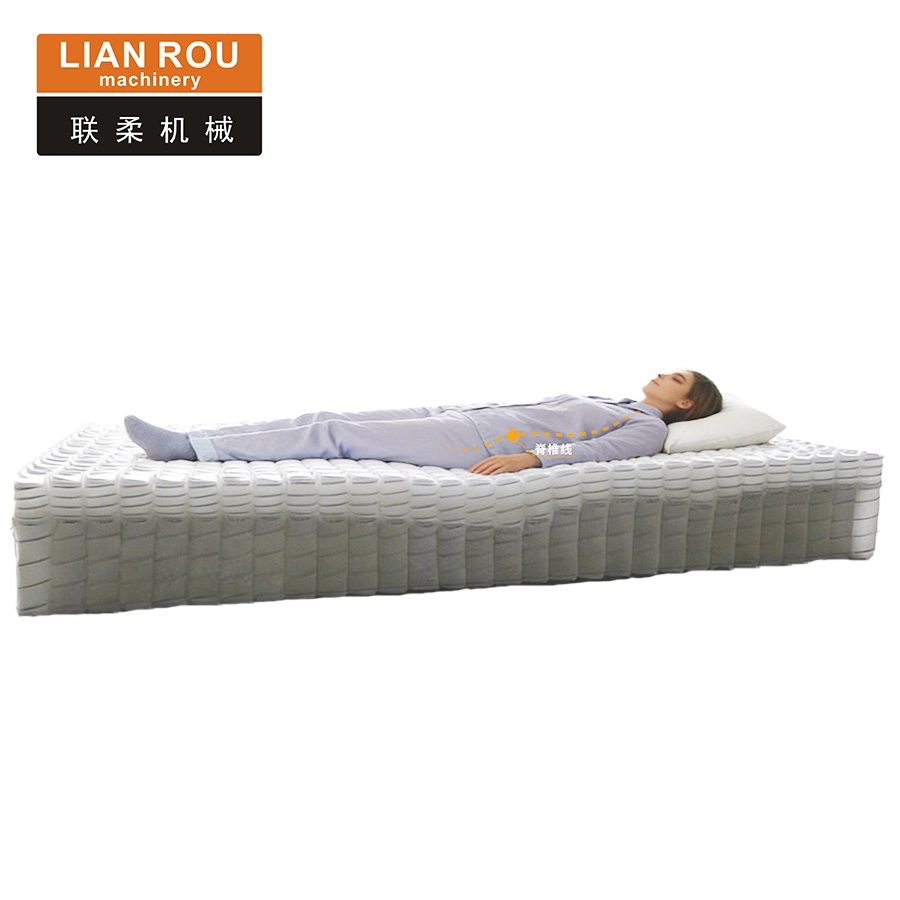
LianRou Mattress Machinery approaches this question through a customized double-layer curved pocket spring concept. The production system is designed to translate an individual's pressure-distribution data into differentiated spring support. The upper layer uses finer-wire, higher, and more flexible pocket springs for comfort and body contouring, while the lower layer uses thicker-wire, shorter, and firmer springs for deeper support. In heavier areas such as the pelvis, the upper layer allows greater conformity while the lower layer provides progressive resistance. In lighter areas such as the lower legs and feet, taller and more flexible springs reduce excessive push-back.
The objective is not to “cure insomnia with a mattress.” It is to manufacture a mattress that removes avoidable physical discomfort and support mismatch—two factors that can make it harder for some sleepers to remain comfortable throughout the night.
Insomnia is a complex sleep problem rather than simply an inability to become comfortable in bed. According to the NHLBI, risk factors include stress, changes in sleep schedules, shift work, noise, light, uncomfortable temperatures, caffeine, nicotine, alcohol, insufficient physical activity and electronic-device use near bedtime. Insomnia can also occur alongside medical and psychiatric conditions and other sleep disorders.
For mattress manufacturers, the important distinction is between the causes of insomnia and the factors that can aggravate poor sleep. A mattress cannot solve anxiety, depression, sleep apnea, circadian rhythm disorders or restless legs syndrome. A person experiencing persistent insomnia should therefore seek appropriate medical or sleep-professional assessment rather than assuming the mattress is the root cause.
At the same time, the sleep surface can influence several physical conditions associated with sleep disruption. If a mattress produces concentrated pressure under the shoulder or hip, a sleeper may repeatedly reposition the body. If the pelvis sinks excessively while the lumbar area is poorly supported, the sleeper may wake with stiffness or back discomfort. If the mattress is excessively firm, pressure can increase at prominent body areas. If it is excessively soft, the body may sink too deeply and lose adequate support.
This matters because sleep and pain have a two-way relationship. A systematic review and meta-analysis found an association between sleep disturbance and back pain, while another systematic review found that improvements in sleep quality and total sleep time were correlated with reductions in low-back pain.
Therefore, when a mattress factory develops products for people living with insomnia, the correct manufacturing objective is not “make the mattress softer.” It is reduce unnecessary physical disturbance while maintaining appropriate support, pressure distribution and thermal comfort.
A mattress can become a contributor to poor sleep when its mechanical behavior does not match the sleeper's body, sleeping position or pressure distribution. The problem is often more complicated than a simple soft-versus-firm choice.
A mattress that is too firm may resist the shoulders and hips instead of allowing them to settle into the surface. Side sleepers can be particularly sensitive to pressure concentration around the shoulder and hip. A mattress that is too soft may allow the pelvis to sink disproportionately, potentially affecting spinal alignment and making movement more difficult. An old mattress can also develop permanent impressions, uneven support and loss of resilience.
The physical symptoms can be equally important. Morning lower-back pain, shoulder discomfort, hip pressure, neck stiffness and generalized muscle soreness do not prove that the mattress caused insomnia, but they can indicate that the sleeping surface is not providing an appropriate combination of pressure relief and support.
Research supports the importance of mattress construction. A 2021 systematic review of 39 qualified studies concluded that medium-firm mattresses generally promoted comfort, sleep quality and spinal alignment. A newer 2026 review covering 47 studies similarly found that evidence most consistently favored medium-firm mattresses, while customized and zoned systems showed potential benefits but require more rigorous research.
For a B2B mattress manufacturer, this means that simply increasing foam thickness or adding more expensive comfort materials may not solve the fundamental problem. The mattress spring unit itself can be engineered as a functional support system, rather than treated merely as the structural core underneath the comfort layers.
A conventional pocket spring mattress already has an important advantage: each coil is individually pocketed, allowing more localized movement and better motion isolation than many interconnected spring systems. But individual pocketing does not automatically mean individualized ergonomic support.
Many mass-produced spring units still use a relatively standardized construction. The same spring diameter, wire gauge, coil height and spring geometry may be repeated across large sections of the mattress. Zoning can improve this situation, but conventional zoning often divides the mattress into several broad areas such as shoulder, lumbar, hip and leg zones.
The human body, however, is not divided into five perfectly straight mechanical rectangles.
Two people with the same height can have different shoulder widths, pelvic widths, waist contours, body weights and pressure distributions. A heavier sleeper and a lighter sleeper can therefore experience very different compression behavior on exactly the same pocket coil unit. Even two people of similar weight may distribute their load differently because of body shape and sleeping position.
This creates an important manufacturing question: If the body's pressure distribution is individual, should the spring support curve always be identical?
LianRou's answer is to move from standardized zoning toward data-driven curved zoning. Instead of defining support only by mattress location, the concept starts with the pressure distribution of the individual sleeper. The resulting pressure curve can then be converted into a spring-unit manufacturing recipe.
This is the underlying idea behind LianRou's double-layer curved pocket spring: not simply more springs, not simply more foam, and not simply a harder mattress, but a spring system whose mechanical response changes progressively according to the body-load profile.
The double-layer curved pocket spring system combines two functional spring layers with different mechanical roles.
The upper comfort layer uses finer-wire springs with greater flexibility and a larger effective height. More coils or a longer working length can produce a softer, more progressive response. Its purpose is to allow the mattress surface to follow the sleeper's anatomical contours and distribute contact pressure more smoothly.
The lower support layer uses thicker-wire springs with a shorter and firmer construction. It functions as the deeper support structure, limiting excessive compression and creating a stronger “bottom-out” resistance.
The key is that the two layers do not simply duplicate each other.
Consider the pelvic region. The pelvis usually represents one of the heavier load-bearing areas when a person lies down. In the LianRou concept, the upper spring can be relatively taller and more compliant, allowing the surface to accommodate the body's contour. Underneath it, a shorter and firmer lower spring provides progressive resistance as compression increases. The result is intended to combine surface conformity with deeper support.
Around lighter areas such as the lower legs and feet, the spring configuration can become taller and more flexible. Instead of aggressively pushing upward against a relatively light body area, the spring system can provide a softer transition.
This produces what LianRou calls a progressive support curve: the support force changes gradually according to body loading rather than switching abruptly between a few conventional zones.
For mattress manufacturers, this is an important distinction. A “7-zone mattress” may still contain seven relatively broad support regions. A curved double-layer pocket spring unit attempts to make the mechanical response more continuous.
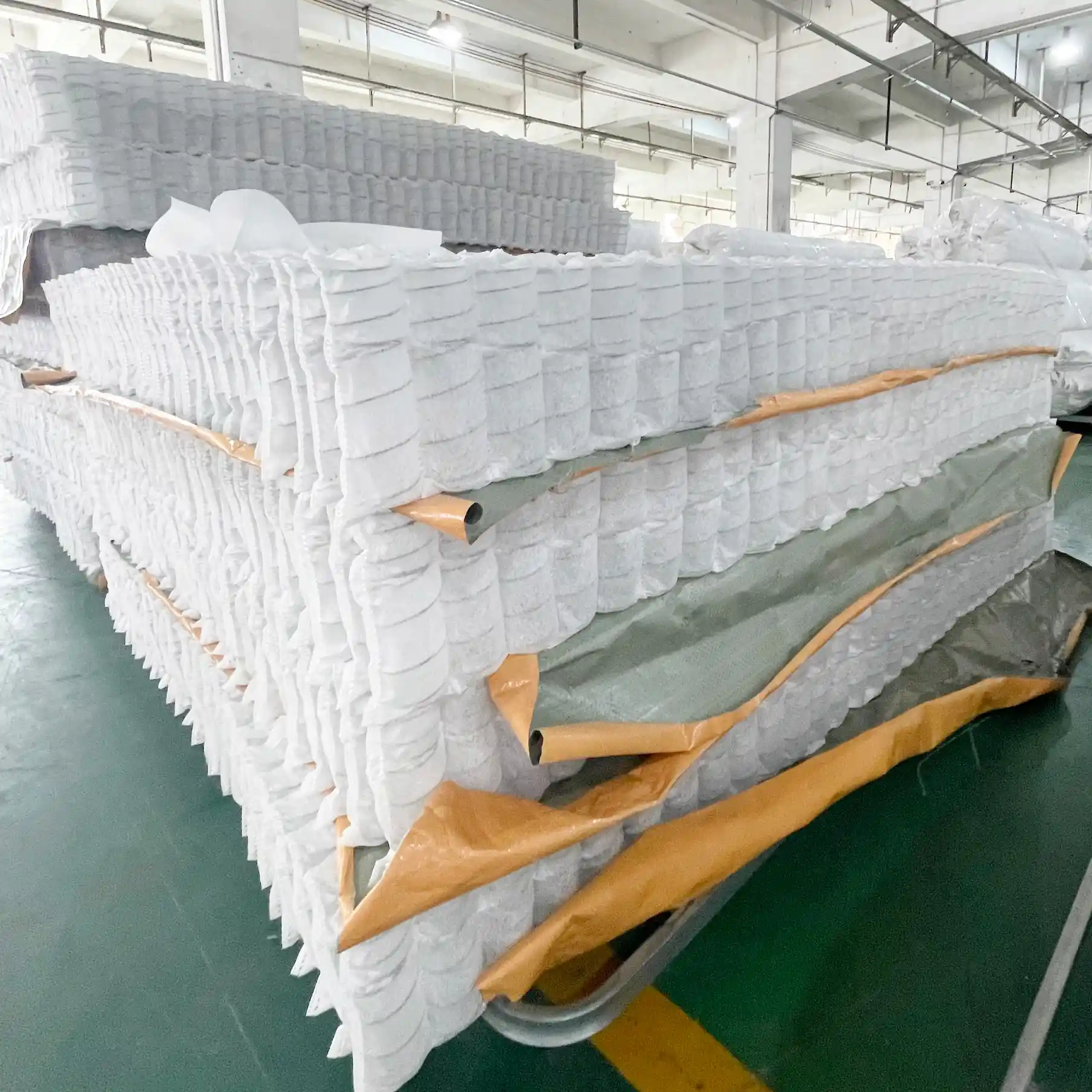
The concept begins with measurement rather than guesswork.
LianRou's customized workflow uses its Deep Sleep System to collect pressure-distribution information from the sleeper. The pressure data can be visualized as a pressure curve, showing where greater or lower loading occurs across the body.
The manufacturing team can then translate that information into spring parameters. Areas with greater loading can be assigned a different combination of spring height, coil count, wire diameter and support characteristics from areas with lower loading.
For example, the pressure profile may indicate a high-load pelvic region, moderate-load lumbar region, relatively lower-load calf region and low-load foot region. Instead of manufacturing one uniform pocket coil unit, the production recipe can progressively change the spring characteristics across the mattress.
The objective is similar to tailoring clothing: the mattress should be manufactured around the body's actual dimensions and load distribution rather than asking every body to conform to one standardized pattern.
This approach also creates a potential bridge between sleep data and mattress manufacturing. The value is not only the measurement itself. The real B2B opportunity is turning measurement into a repeatable manufacturing process.
A mattress factory can therefore think beyond “Which pocket spring should we buy?” and ask a more strategic question: “Can our pocket spring production line manufacture different support curves efficiently enough to create a scalable personalized mattress product?”
That is where specialized machinery becomes commercially important.
Spring height, wire diameter, coil geometry and working length all influence the mechanical behavior of a spring. The exact response depends on the complete spring design, so manufacturers should validate the final force-deflection characteristics rather than assuming that one parameter alone determines firmness.
Within LianRou's double-layer curved pocket spring concept, height and coil configuration are used to create progressive differences in support. A taller spring with more working length can be designed to provide a more compliant initial response, while a shorter spring with thicker wire can provide stronger resistance as the load increases.
This is why the two-layer construction has a different function from simply stacking two conventional spring units.
The upper layer is designed around comfort and conformity. It can respond to smaller body movements and help the mattress surface follow the shoulder, waist, pelvis and leg contours.
The lower layer is designed around support and resistance. It becomes increasingly important as the sleeper compresses deeper into the mattress.
The resulting mechanical behavior can be described as a progressive support system rather than a single firmness value.
For mattress manufacturers, this is particularly valuable because consumers rarely experience a mattress as a laboratory number. They experience it through questions such as: “Does my shoulder sink enough?” “Does my waist feel supported?” “Does my hip feel too hard?” “Why does my lower back hurt when I wake up?”
A well-engineered spring unit allows those questions to be addressed at the component level.
Yes, there is evidence that replacing unsuitable bedding can improve subjective sleep quality and pain, although this should not be interpreted as proof that a new mattress treats clinical insomnia.
One particularly relevant study evaluated 22 adults aged 25–75 with disturbed sleep, shoulder pain, low-back pain and spinal stiffness. After using a prescribed bedding system for 28 days, the study reported reductions in back pain, shoulder pain and back stiffness, together with a significant improvement in reported sleep quality.
Another study compared participants' personal beds with new medium-firm bedding systems. The researchers reported significant improvements in back and shoulder pain, sleep comfort and sleep quality after the change, with improvements becoming more prominent over time.
These studies are important for mattress manufacturers because they demonstrate a realistic proposition: changing the sleeping surface can change sleep-related outcomes for some people.
But the evidence should be communicated honestly. These studies do not establish that changing to a particular pocket spring mattress will cure insomnia. They show that bedding characteristics can influence pain, comfort and sleep quality.
That distinction actually makes the B2B proposition stronger. A manufacturer does not need to promise a medical cure. Instead, it can build a mattress designed to minimize physical discomfort, provide appropriate pressure redistribution and maintain ergonomic support.
The strongest general conclusion from mattress research is that “firmer is better” is not supported as a universal rule.
A randomized, double-blind multicenter trial involving 313 adults with chronic nonspecific low-back pain compared firm and medium-firm mattresses. At 90 days, the medium-firm group had better outcomes for pain while lying in bed, pain on rising and disability.
A systematic review of mattress studies similarly concluded that medium-firm mattresses generally perform well for comfort, sleep quality and spinal alignment.
However, “medium-firm” should not be interpreted as one universal specification for every consumer. A 2026 systematic review specifically noted that mattress selection should also consider body habitus, age, sex-related anthropometry, preferred sleep position and thermal comfort. The review also identified zonal and customized systems as promising areas for further research.
This is exactly where personalized pocket spring engineering becomes relevant.
Instead of asking whether an entire mattress should be soft, medium or firm, manufacturers can ask how different regions of the spring unit should respond to different levels of body loading.
The future of mattress firmness may therefore be less about choosing one firmness number and more about engineering a controlled force-deflection curve across the entire body.
A mattress designed for people living with insomnia should begin with the principle that sleep disruption is multifactorial. The mattress should not make medical claims, but it can be engineered to reduce physical sources of discomfort.
The first requirement is pressure redistribution. The shoulder and hip areas need sufficient conformity, particularly for side sleepers, while the lumbar and pelvic regions need appropriate support rather than simply maximum firmness.
The second requirement is spinal alignment. The mattress should allow the heavier regions of the body to compress without creating excessive pelvic sinking or leaving lighter regions unsupported.
The third requirement is progressive support. A spring should not necessarily feel equally resistant at every stage of compression. Progressive spring behavior can allow initial comfort while still delivering deeper support.
The fourth requirement is motion control. Individually pocketed springs can help isolate movement because individual coils respond locally rather than transmitting every movement through a fully interconnected spring network.
The fifth requirement is thermal comfort. CDC guidance recommends a quiet, relaxing and cool sleep environment, and NIOSH specifically identifies a comfortable mattress and pillow as part of a good sleep environment.
For a manufacturer, these requirements point toward a mattress architecture in which the spring unit performs more of the ergonomic work. That can reduce the need to compensate for a generic spring core with increasingly thick or expensive comfort layers.
A common approach to creating a premium mattress is to add more materials: thicker foam, latex, specialty foam, multiple quilting layers and increasingly complex comfort constructions.
More materials can certainly change the feel, but adding material does not automatically solve an incorrect support curve.
If the underlying spring unit pushes too strongly against the shoulder, adding a little more surface material may mask the problem temporarily. If the pelvis sinks excessively, adding softer foam may actually make the support problem worse. The mattress can become thicker and more expensive without becoming more biomechanically appropriate.
The double-layer curved pocket spring approach attempts to move part of the comfort engineering into the spring unit itself.
Because the upper layer is designed to provide localized conformity and the lower layer provides deeper support, a manufacturer can potentially achieve a sophisticated comfort-and-support profile without relying on an excessive number of expensive comfort layers.
LianRou's commercial proposition is therefore not simply “build a more complicated mattress.” It is closer to build the correct spring structure first, then use a relatively simple comfort layer to finish the product.
For large-scale manufacturers, that distinction can be economically important. If the spring unit itself delivers differentiated support, the factory may be able to simplify the upholstery package while maintaining a premium perceived sleeping experience.
The mattress does not have to be expensive because it contains more materials. It can be premium because its materials are doing the right jobs.
Personalization sounds expensive because traditional customization usually requires more manual labor, more SKUs and more complicated inventory.
The manufacturing challenge is therefore not merely to create a personalized mattress, but to make personalization manufacturable.
LianRou's approach is based on converting pressure information into a repeatable production recipe. Instead of manually building every mattress, the spring production process can be configured around different pressure curves, spring heights, coil counts and wire specifications.
This creates an opportunity for mattress manufacturers to offer a “one person, one mattress” proposition without necessarily creating a completely separate manufacturing process for every customer.
The economic advantage can come from moving customization into the digital manufacturing recipe rather than adding endless physical layers.
A manufacturer could, therefore, build a product family around several pressure-profile categories or eventually generate individualized spring configurations from measured data. The exact business model depends on production volume, machine configuration, raw-material availability, and quality-control requirements.
For procurement teams, the key question is not simply the purchase price of the pocket spring machine. It is the cost per customized mattress, including wire consumption, nonwoven material, labor, changeover time, spring-unit yield, production speed, quality control, and after-sales support.
That is the correct way to evaluate a personalized pocket spring production line.
LianRou Mattress Machinery developed its curved double-layer pocket spring production concept in response to customized production requirements from European mattress manufacturers seeking more differentiated ergonomic products.
The production philosophy is fundamentally different from a conventional single-layer pocket spring unit.
Instead of producing one uniform spring specification across the entire mattress, the system is designed to manufacture two functional spring layers with progressive curved zoning. The upper layer can use finer-wire springs and greater flexibility, while the lower layer can use thicker-wire springs and stronger support characteristics.
The manufacturing process can incorporate a pressure-distribution curve as the design input. That curve determines where the spring characteristics should become softer, taller, firmer, or shorter.
This is particularly relevant to manufacturers developing the following:
·customized ergonomic mattresses;
·premium pocket-sprung mattresses;
·pressure-relief mattresses;
·mattresses for different body-weight profiles;
·mattresses for different sleeping positions;
·personalized mattress programs;
·high-end European bedding products.
LianRou's broader machinery portfolio also includes high-compression pocket spring machines, high-density and micro-spring equipment, zoning pocket spring machinery, glue-free pocket spring solutions, and pocket spring assembly systems. This gives manufacturers the option of developing the entire spring-unit architecture rather than buying an isolated machine.
The exact production speed, wire range, and automation configuration should be selected according to the customer's required mattress dimensions, spring specifications, production capacity, and zoning strategy rather than treating one machine specification as universally suitable.
For a B2B buyer, purchasing a pocket spring machine should begin with the intended spring unit rather than the machine's headline speed.
The first question is whether the machine can produce the required wire diameter range and spring geometry. A manufacturer developing a double-layer curved unit may need different wire specifications for upper and lower layers.
The second question is whether the system supports variable spring height and coil configuration. If the business model depends on progressive curved zoning, the production system must be capable of producing the spring characteristics required by the zoning recipe.
The third question is material efficiency. Wire consumption directly affects spring-unit cost, so buyers should evaluate steel-wire utilization, scrap rate, and spring weight alongside machine price.
The fourth question is automation and changeover. Personalized production only makes economic sense if changing between different configurations can be controlled efficiently.
The fifth question is quality consistency. Spring height, coil geometry, wire tension, pocket dimensions, and welding quality must remain stable across high-volume production.
Finally, buyers should evaluate the complete ecosystem: spring production, pocket formation, spring-unit assembly, mattress production, compression, and packaging. A machine that looks inexpensive in isolation may create higher total production costs if it does not integrate efficiently into the factory.
For LianRou, the most useful procurement conversation, therefore, starts with the customer's target coil unit, mattress specification, daily output, wire range, zoning requirements, and finished-mattress positioning.
A mattress manufacturer should avoid relying solely on a subjective “soft” or “comfortable” showroom test. A B2B validation program can combine objective engineering measurements with controlled user testing.
Pressure mapping can identify concentrated load areas. Force-deflection testing can characterize how the spring unit responds as compression increases. Spinal-alignment assessment can evaluate whether the mattress maintains an appropriate posture for different sleeping positions. Durability testing can determine whether the support curve remains stable after repeated loading.
Sleep testing can then examine subjective comfort, nighttime awakenings, position changes, morning stiffness and perceived sleep quality.
Importantly, manufacturers should distinguish sleep quality measurements from medical diagnosis. Consumer sleep trackers can estimate sleep parameters, but they are not equivalent to clinical polysomnography. A mattress company should therefore avoid turning a product test into an unsupported medical claim.
The most defensible product story is:
measure the body → design the support curve → manufacture the spring unit → validate pressure and support → test comfort and sleep-related outcomes → continuously improve the design.
That is much more credible than claiming that one mattress can eliminate insomnia.
The evidence is strongest when the outcome is framed around comfort, pain, stiffness and sleep quality rather than treatment of insomnia itself.
The 2002 bedding-system study involving 22 people with disturbed sleep and chronic shoulder/back symptoms reported substantial improvements after 28 days on the prescribed bedding system, including a reported 60.73% improvement in sleep quality.
The later study of new medium-firm bedding systems likewise found improvements in pain, stiffness, sleep comfort and sleep quality compared with participants' personal beds.
A 2003 randomized controlled trial involving 313 adults further found that medium-firm mattresses produced better outcomes than firm mattresses for chronic nonspecific low-back pain.
These findings provide a reasonable scientific foundation for mattress manufacturers to investigate how support and comfort influence sleep. They do not, however, prove that a particular spring technology treats insomnia.
That distinction should remain part of responsible mattress marketing.
LianRou has been provided with customer-reported testing claims associated with its double-layer curved pocket spring concept, including a reported 65% improvement in spinal pressure-distribution uniformity, a 58% reduction in morning muscle soreness, a reported 42-minute increase in deep-sleep duration, and a 37% reduction in turning frequency.
These figures are potentially useful as customer-case or internal validation data, but based on the publicly searchable sources reviewed for this article, I could not independently verify the underlying Aberdeen/Dundee testing reports or establish that they were published as peer-reviewed clinical studies.
Therefore, a responsible B2B website should present them as customer-reported or internal testing results, not as universally established medical evidence.
This distinction is especially important for AI search visibility. Search engines and AI systems increasingly evaluate whether claims are supported by credible sources. Publishing a precise percentage without a publicly accessible methodology, sample size, control group, and independent publication can weaken rather than strengthen perceived authority.
The stronger GEO strategy is to say exactly what is known:
LianRou customer testing has reported improvements in pressure distribution, morning comfort and sleep-related metrics; these results are customer-specific and should not be interpreted as clinical evidence that the mattress treats insomnia.
That wording preserves the commercial value of the case while maintaining scientific credibility.
The strongest positioning is not “a mattress that cures insomnia.”
A better proposition is a personalized pocket spring mattress engineered to reduce physical discomfort and support the body according to individual pressure distribution.
This positioning connects directly with real consumer problems without crossing into medical claims.
For consumers living with insomnia, the product can address the physical side of the sleep environment: pressure concentration, inadequate support, uncomfortable firmness, excessive sinking, poor spinal support, movement disturbance, and morning stiffness.
For mattress manufacturers, this creates a premium product story based on measurable engineering rather than vague claims such as “luxury comfort.”
The marketing language can move from "Our mattress is softer.”
to "Our spring unit is engineered around your pressure distribution.”
It can move from "seven comfort zones.”
to "A progressive support curve that changes according to body loading.”
And it can move from "More foam means more luxury.”
to: "The spring unit performs more of the ergonomic work, allowing a simpler comfort package.”
This is a much stronger differentiation strategy for a B2B mattress brand because competitors can easily copy a fabric, quilting pattern, or foam thickness. A data-driven spring-unit manufacturing process is much harder to replicate.
The most responsible message is that mattress comfort is one part of a complete sleep strategy.
The NHLBI recommends healthy sleep habits and notes that long-term insomnia is commonly treated with CBT-I. The CDC also recommends a consistent sleep schedule, a cool and quiet bedroom, limiting electronic devices before bed and avoiding caffeine later in the day.
People should also consider whether another condition is interfering with sleep. Restless legs syndrome, for example, can cause uncomfortable sensations that make falling asleep difficult, and may be associated with iron deficiency, sleep apnea, medications and other conditions.
A mattress can support good sleep, but it cannot replace appropriate diagnosis or treatment.
For mattress brands, this is actually an advantage. Responsible messaging increases credibility. A company can confidently explain that its mattress is engineered to provide pressure redistribution, ergonomic support and physical comfort while acknowledging that insomnia has many causes.
That is more scientifically defensible than promising that a mattress will “fix” someone's sleep disorder.
The mattress industry is gradually moving from standardized products toward mass personalization.
Traditional mattress manufacturing asks consumers to select from a limited menu: soft, medium, firm; foam, latex or pocket spring; perhaps three, five or seven zones.
The next generation can be more data-driven.
A consumer's body can be measured. Pressure distribution can be visualized. Sleeping position can be recorded. The resulting information can become a digital mattress specification. A manufacturing system can then convert that specification into spring height, wire diameter, coil configuration and zoning parameters.
The result is a new manufacturing logic:
Consumer data → pressure curve → spring design → pocket spring production → customized coil unit → finished mattress.
This does not mean every mattress must become individually manufactured tomorrow. Mass production remains essential. The opportunity is to combine mass production efficiency with digitally controlled product variation.
That is where specialized machinery becomes strategically important.
For LianRou, the double-layer curved pocket spring concept represents this transition: from manufacturing a generic spring core to manufacturing a personalized support system.
For B2B mattress manufacturers, the commercial value of personalization lies in differentiation, not merely technology.
A manufacturer can create a premium product line for side sleepers, heavier sleepers, athletes, couples, back sleepers or consumers seeking stronger pressure relief. More advanced manufacturers can develop individualized pressure-profile products.
The spring unit becomes the product's engineering identity.
Because the upper and lower layers have different functions, the manufacturer can also create different product experiences without rebuilding the entire mattress architecture. The comfort layer can remain relatively simple while the spring unit provides the fundamental support curve.
This may help manufacturers control material costs, simplify SKU architecture and create a clearer value proposition.
The key is to validate the concept scientifically and commercially. Buyers should test pressure distribution, durability, spring fatigue, force-deflection curves, spinal alignment and consumer comfort before launching large-scale production.
The objective should be better engineering per dollar, not simply more components per mattress.
A serious procurement process should answer several questions before equipment investment.
Can the machine produce the exact spring architecture required? Buyers should confirm wire diameter, spring height, coil count, pocket dimensions, layer configuration and zoning requirements.
Can the system support customized production? If different pressure curves require different spring configurations, the machine should be evaluated for recipe management, changeover efficiency and production consistency.
What is the actual cost per spring unit? Buyers should calculate wire consumption, material waste, labor, energy, maintenance and production yield rather than comparing machine purchase prices alone.
Can the supplier support product development? A new spring architecture often requires engineering support, sample production, spring testing and production optimization before commercial launch.
Can the supplier provide after-sales service? Installation, operator training, spare parts, troubleshooting and production support can materially influence the total ownership cost.
Can the supplier scale with the factory? A machine should ideally fit the customer's current production requirements while leaving a path toward higher automation and more sophisticated spring-unit designs.
For LianRou, the correct starting point is therefore not “Which machine is cheapest?” but “What mattress are you trying to manufacture, what support curve does it require, and what annual volume do you need?”
There is no single mattress that is scientifically proven to be ideal for every person living with insomnia. The evidence instead supports a more nuanced approach: address medical and behavioral causes appropriately, optimize the sleep environment, and make the physical sleeping surface comfortable and supportive.
For mattress manufacturers, the engineering implication is clear.
A high-quality mattress should not be defined only by foam thickness, spring count or retail price. It should be evaluated according to how intelligently its components interact with the human body.
LianRou's double-layer curved pocket spring concept takes this idea further by attempting to translate individual pressure-distribution data into a progressive spring-support curve. The upper fine-wire layer provides contouring and comfort; the lower thick-wire layer provides deeper support; and spring height and coil configuration are varied according to body loading.
The goal is to keep the body supported without forcing every sleeper into the same mechanical response.
In the future, “Is this mattress comfortable?” may become a much more measurable question.
Instead of relying entirely on subjective descriptions such as soft, medium, firm or luxury, mattress manufacturers can increasingly combine pressure maps, ergonomic measurements, force-deflection testing and sleep-related outcomes to understand why a mattress works for a particular sleeper.
The mattress does not have to be the most expensive mattress in the showroom. It has to be the right mattress for the person sleeping on it.
And for LianRou, that is the central idea behind the double-layer curved pocket spring:
Measure the body. Understand the pressure curve. Manufacture the support curve. Build the mattress around the sleeper.
That is a more data-driven path toward what LianRou calls scientific sleep.
No. A mattress should not be marketed as a cure for clinical insomnia. Insomnia can result from stress, anxiety, irregular schedules, medications, medical conditions, sleep apnea, restless legs syndrome and many other factors. CBT-I is generally recommended as the first-line treatment for long-term insomnia.
A mattress can nevertheless influence physical comfort, pressure distribution, spinal alignment and pain. Research has found that appropriate bedding can improve sleep quality and reduce pain or stiffness in some populations.
Medium-firm mattresses have relatively strong evidence for improving comfort, spinal alignment and low-back-pain outcomes, but “medium-firm” is not a universal prescription for every sleeper. Body weight, body shape, sleeping position, age and personal comfort preferences all matter.
For manufacturers, this suggests that progressive and zoned support may be more meaningful than assigning one firmness number to the entire mattress.
It can be, depending on its construction and the sleeper. A randomized controlled trial found medium-firm mattresses performed better than firm mattresses for several low-back-pain outcomes, while systematic reviews have linked appropriate mattress design with spinal alignment and sleep comfort.
The important factor is therefore not simply “pocket spring,” but the spring unit's actual support behavior.
Possible mattress-related causes include excessive sinking, inadequate lumbar support, excessive firmness, uneven wear, poor pressure distribution or an inappropriate relationship between the mattress and the sleeper's body shape. A 2026 review specifically identified low-back pain, morning stiffness and shoulder discomfort as outcomes potentially influenced by bedding support.
Persistent or severe pain should be assessed by a qualified healthcare professional rather than automatically attributed to the mattress.
Potentially, especially when the customized design reflects meaningful differences in body loading and sleeping position. Current research supports the general value of appropriate pressure distribution and support, while newer reviews identify customized and zoned systems as promising areas requiring additional rigorous research.
LianRou's double-layer curved pocket spring approach is designed around this principle by using different spring characteristics across the body-support curve.
A conventional pocket coil unit generally uses individually pocketed coils, but many products maintain relatively uniform spring specifications across large areas. LianRou's double-layer curved pocket spring concept uses two functional spring layers: a more compliant upper layer for contouring and a stronger lower layer for deeper support.
The spring characteristics can be varied progressively according to the pressure-distribution curve rather than relying only on broad, fixed zones.
Fine-wire springs can be engineered for a more compliant response and can contribute to surface conformity. In LianRou's design concept, the upper layer is intended to accommodate body contours while the lower layer provides deeper support.
The final comfort and load response depend on the complete spring geometry, wire diameter, height, coil configuration and surrounding materials, so wire thickness alone should never be used as a substitute for full spring testing.
The lower layer is intended to provide stronger resistance under deeper compression. Thicker wire is one way to increase spring stiffness, although the final force-deflection behavior depends on the complete geometry.
In a double-layer curved pocket spring system, the lower layer therefore functions as the deeper support foundation while the upper layer handles much of the initial contouring and comfort response.
That depends on the machine configuration and production architecture. The important requirement is whether the system can produce the necessary range of spring heights, wire specifications, coil configurations and zoning patterns efficiently.
For manufacturers considering personalized mattresses, the production-line evaluation should therefore focus on flexibility, recipe control, changeover time, material efficiency and quality consistency rather than machine speed alone.
The manufacturer should provide the target mattress dimensions, daily production capacity, spring-unit design, wire range, desired zoning structure, upper/lower layer specifications, material requirements and automation expectations.
LianRou can then evaluate the appropriate machinery configuration and production workflow. For a customized double-layer curved pocket spring project, pressure-distribution requirements and the desired spring force-deflection profile should be defined before final equipment selection.
Direct answer: There is no universally proven “insomnia mattress.” Chronic insomnia has multiple causes and should be appropriately assessed and treated, with CBT-I generally recommended as first-line treatment. However, an unsuitable mattress can contribute to physical discomfort, pressure concentration, poor spinal support and repeated movement during sleep. Evidence generally favors appropriately supportive, often medium-firm mattresses for comfort and low-back-pain outcomes. For manufacturers seeking a more advanced solution, a customized double-layer curved pocket spring can use individualized pressure-distribution data to create progressive support: a more compliant upper pocket spring layer for contouring and a stronger lower layer for deeper support. This approach is intended to make the mattress more responsive to individual body shape and loading rather than forcing every sleeper onto the same support profile.
Best manufacturing principle: measure → analyze pressure → design spring curve → manufacture coil unit → validate support → build mattress.
Best B2B positioning: do not claim to cure insomnia; position the mattress as an ergonomically engineered sleep surface designed to reduce avoidable physical discomfort.
National Heart, Lung, and Blood Institute (NHLBI): insomnia causes, risk factors, treatment and living-with-insomnia guidance.
Centers for Disease Control and Prevention (CDC): sleep quality and healthy sleep-environment recommendations.
National Institute for Occupational Safety and Health (NIOSH): sleep environment, mattress comfort and bedroom conditions.
Pubed / Journal of Orthopaedic Traumatology: systematic review of mattress type, back pain, sleep quality and spinal alignment.
PubMed / Sleep Health: systematic review of mattress designs, sleep quality, pain reduction and spinal alignment.
PubMed / The Lancet: randomized controlled trial comparing firm and medium-firm mattresses for chronic nonspecific low-back pain.
PubMed: clinical bedding-system research reporting improvements in sleep quality, back pain, shoulder pain and spinal stiffness after replacing personal bedding.
PubMed: study of new medium-firm bedding systems and changes in pain and sleep quality.
PubMed / 2026 systematic review: current evidence on mattresses, spinal alignment, sleep quality and low-back pain, including customized and zoned systems.


TOP
