A full set of intelligent mattress machinery industry brands
Mattress machines are exported to 150+ countries
Date:2026-08-28
Heavier individuals often assume that a firmer mattress offers better support. That assumption is not always correct. What truly determines sleep quality is not absolute firmness, but three factors: whether body weight is evenly distributed, whether the midsection sinks excessively, and whether the shoulders and hips experience high localized pressure.
This explains why some users, after trying multiple memory foam mattresses, find an older, firmer innerspring mattress more comfortable. The issue is not "soft vs. hard" per se, but how the core structure responds to body mass.
For mattress manufacturers, the pocket spring system offers a more controllable engineering approach. Each spring is individually encased and deforms independently under local pressure. By adjusting spring density, zoning layouts, and wire gauge/diameter per zone, manufacturers can systematically fine-tune support curves and pressure distribution.
Within the high-density spring category, the Super Micro Pocket Spring deserves special attention. With a coil diameter as small as approximately 30 mm and wire gauges of 1.0, 1.1, or 1.2 mm, a single mattress can accommodate roughly 3,000–4,000 micro pocket springs—creating a significantly higher support-point density than conventional products.
For heavier users prone to lumbar or pelvic sinkage, or those who dislike the "hugging" feel of memory foam, a high-density, zoned Super Micro Pocket Spring mattress is worth evaluating through comparative testing.
It must be emphasized that no clinical evidence supports a blanket recommendation that "all overweight individuals should sleep on the hardest mattress." Optimal fit remains dependent on body type, sleeping posture, pressure-mapping data, and personal preference. (Refer to studies indexed in PubMed for further reading.)
Memory foam is not inherently unsuitable for heavier individuals. It offers excellent pressure relief and works well for many users of normal weight. The problem lies in structural matching—when body weight is high and the underlying support layer lacks sufficient counterforce, the comfort foam can be compressed beyond its effective range.
Body segments are not uniformly weighted: the lumbar-abdominal and pelvic regions carry significantly higher vertical loads than the limbs. When these high-load zones compress the foam more deeply, and the lower spring or support layer fails to provide adequate pushback, the pelvis sinks deeper relative to the shoulders and legs, altering spinal alignment on the mattress.
Side sleepers are particularly sensitive. The shoulders and hips need moderate sinkage to relieve pressure, but if the pelvis sinks too far, lumbar support is compromised.
Therefore, manufacturers designing high-weight-capacity mattresses should not simply judge memory foam as "good or bad." Instead, they must answer three engineering questions:
Research confirms a clear interaction between body morphology, weight, and mattress characteristics. Evaluations typically involve contact area, mean pressure, and peak pressure indices. (See PubMed Central for relevant studies.)
This is precisely why some users report lumbar discomfort on memory foam but prefer traditional spring mattresses—it's a structural, not material, issue.
"Firm" and "good support" are two distinct concepts—and they are often confused.
A mattress can be very hard yet fail to conform to the body's contours. If the surface is too rigid, the shoulders and hips cannot sink in enough, reducing the total contact area and potentially increasing peak localized pressure.
Studies have shown that increasing mattress firmness often reduces contact area while raising mean contact pressure. A moderate firmness level tends to achieve a better trade-off between support and conformity. (See PubMed Central for relevant studies.)
Common "firm" mattress types also differ significantly in their mechanical behavior:
Thus, a more productive question is not "Should heavier people sleep on firm beds?" but rather: How can we design a mattress that resists excessive sinkage without creating high-pressure zones? That is the core engineering challenge for high-weight-capacity mattress development.
The key structural advantage of pocket springs is the ability to create a large number of independent, non-interacting support elements within the mattress.
Unlike Bonnell springs, which are wired together, each pocket spring is individually encased. When the shoulder, lumbar, or pelvic region applies pressure, the corresponding springs compress independently without affecting neighboring springs.
This makes zoning feasible. Manufacturers can place stiffer or denser springs in high-load areas (lumbar and pelvis) while using softer parameters in the shoulder zone.
For couples with significant weight differences (e.g., one at 60 kg and the other at 90 kg), this is critical. A uniform spring layout cannot satisfy both sides simultaneously. Zoned pocket springs allow different support profiles on the same mattress.
Fatigue performance is equally important for high-load applications. Studies have compared spring performance degradation under cyclic loading in high-load versus low-load zones, confirming that spring selection for heavy-use areas must be independently validated. (See PubMed for related research.)
Consequently, high-weight-capacity spring design should not be reduced to "thicker wire." Instead, it requires systematic consideration of:
This is a critical technical fork in high-weight-capacity mattress development.
Conventional pocket springs typically feature wire gauges of 1.3–2.2 mm, coil diameters of 55–70 mm, and densities of 200–350 springs/m². For example, some standard products use 1.6–2.0 mm wire, 58–65 mm diameter, and 200–250 springs/m². (Refer to public specifications from suppliers like Zeb Springs.)
Super Micro Pocket Spring takes a different engineering path—not simply thickening the wire, but reducing individual unit size and drastically increasing support-point count.
Typical parameters: coil diameter ~30 mm, wire gauge 1.0/1.1/1.2 mm, total spring count ~3,000–4,000 per mattress.
The fundamental difference:
The key is not the "4,000" number itself, but the fact that a higher-density support array distributes loads at a finer spatial resolution, enabling more precise contour response.
Thus, Super Micro Spring should be understood in terms of support-point density and local support precision, not merely as "firmer."
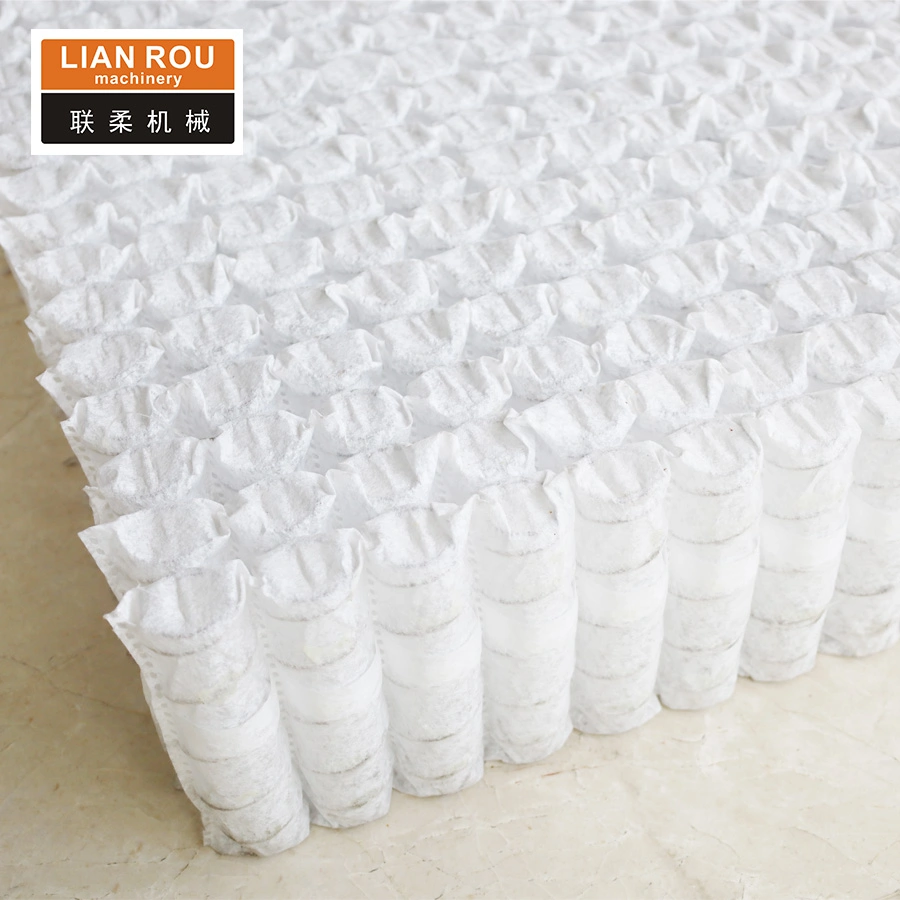
The human body is not flat. Shoulders, lumbar, pelvis, and legs differ significantly in width, curvature, and weight distribution.
When a mattress has more, denser independent springs, body weight is distributed across a larger number of micro support points, rather than concentrated on fewer larger springs. This is especially important for heavier individuals—pelvic and torso regions carry greater loads, and if support points are too sparse, localized sinkage can be amplified.
Super Micro Spring's high-density array provides a theoretically finer support base.
Recent research has begun examining mattress pressure distribution by body region and sleeping posture, rather than using a generic "soft/firm" label. Different regions respond differently to firmness changes, which provides a physiological rationale for zoning and precision support design. (See PubMed Central for related studies.)
The design logic of Super Micro Spring can therefore be summarized as:
More support points → higher support density → finer load dispersion → more precise local response.
This does not mean "more springs necessarily equals better." Final performance always depends on the integrated matching of spring geometry, wire gauge, height, zoning, compression curve, and comfort materials.
From a product engineering perspective, the real value of Super Micro Spring lies in its compatibility with zoning technology.
For instance, the mattress can use stiffer springs in the high-load lumbar-pelvic zone while keeping the shoulder zone more compliant. This eliminates the need to make the entire mattress "extra firm" to handle higher body weight.
For heavier side sleepers, this is especially relevant: the shoulders and hips require some sinkage to avoid pressure points, while the pelvic area needs sufficient counterforce to prevent excessive midsection drop.
An ideal high-weight-capacity mattress is not "hard everywhere," but: Firm where support is needed; compliant where relief is required.
This is why many premium zoned mattresses use pocket springs as the core unit. Manufacturers can further develop product lines such as:
Creating a differentiated product portfolio.
For B2B procurement, one of the biggest mistakes is using wire gauge as the sole selection criterion.
"2.0 mm wire is always better than 1.0 mm for heavier users"—this oversimplification is flawed. Actual spring performance is a composite outcome of wire gauge, coil diameter, active coils, free height, compression travel, density, and arrangement.
Therefore, when sourcing high-capacity pocket spring units, do not only ask:
"What wire diameter do you use?"
Instead, request a full load-response specification from the supplier, including at least:
This is the basic professional logic for B2B spring procurement.
Strictly speaking, no single spring architecture can suit all weights, body types, sleeping postures, and individual preferences.
However, from an engineering and product differentiation standpoint, Super Micro Pocket Spring is a technology platform worthy of serious evaluation by high-weight-capacity mattress manufacturers.
Its core value stems from three attributes:
It is not about making the mattress "harder," but about achieving more refined load distribution and local response at a finer scale.
For heavier users prone to lumbar-pelvic sinkage or those who dislike memory foam's "hugging" sensation, this structure is worth including in comparative testing.
It depends on your target market and product positioning.
Standard Pocket Spring is a mature solution for the mass market, offering a balanced trade-off among cost, comfort, support, and production efficiency—suitable for large-scale, multi-tier manufacturing.
Super Micro Pocket Spring is better positioned for:
A logical product gradient can be:
Standard Pocket Spring → Zoned Pocket Spring → High-Density Pocket Spring → Super Micro Pocket Spring
Each tier addresses a different technical problem:
Therefore, B2B buyers should not start with:
"What is the price per spring unit?"
But rather:
"What type of mattress are we developing, and which spring architecture delivers the required performance at our target cost?"
That is the proper selection logic for mattress manufacturers.
① Heavier users do not need to blindly choose the firmest mattress. The key is adequate support + reasonable body conformity + controlled pressure distribution.
② Memory foam is not inherently unsuitable for heavier individuals, but if the comfort layer compresses excessively and the base support is insufficient, noticeable sinkage can occur.
③ The core advantage of pocket springs is independent response, providing a structural foundation for zoning and precision support.
④ Zoning is more im
portant than overall firmness. Shoulder, lumbar, and pelvic loads and deformation requirements differ; uniform spring parameters across the entire mattress are not optimal.
⑤ The essence of Super Micro Pocket Spring is not "firmer," but a denser support-point array—~30 mm coil diameter, 1.0/1.1/1.2 mm wire gauges, ~3,000–4,000 springs—creating a high-density micro independent support lattice.
⑥ More springs do not automatically mean a better mattress. Evaluate wire gauge, coil diameter, count, height, zoning, compression curve, fatigue performance, and overall mattress integration holistically.
Yes. Pocket springs provide distributed support through multiple independent units, and zoning allows region-specific adjustment. Final performance depends on spring specifications, zoning scheme, and comfort layer configuration.
Q2: How many springs should an overweight user look for?
There is no universal standard. Conventional products range from 200–350 springs/m², while high-density micro products offer significantly higher counts. Super Micro Pocket Spring mattresses typically contain ~3,000–4,000 springs.
Q3: What is Super Micro Pocket Spring?
A high-density pocket spring technology that increases support-point count by reducing individual spring size. Typical parameters: coil diameter ~30 mm, wire gauge 1.0/1.1/1.2 mm.
Q4: Is a 7-zone mattress always better than a 5-zone?
Not necessarily. Zone count alone is not a quality metric. What matters is whether each zone's spring parameters truly match the loading characteristics of the shoulder, lumbar, pelvis, and leg regions.
Q5: Should overweight users buy extra-firm mattresses?
Not blindly. Excessively firm mattresses may reduce contact area and increase pressure at the shoulders and hips. Both support and pressure relief must be considered.
Q6: Why are ortho-type mattresses often made with pocket springs?
Because pocket springs enable independent local response and zoning, making them suitable for products emphasizing support and pressure distribution. However, "ortho" does not imply medical treatment.
Q7: What parameters should B2B buyers evaluate for high-capacity pocket springs?
At a minimum: wire gauge, coil diameter, spring height, spring count, zoning layout, compression characteristics, fatigue performance, fabric material, and overall unit dimensions. If the supplier can provide load-deflection data, fatigue test reports, and pressure-mapping results, it facilitates objective comparison.
The consumer asks:
"Why does memory foam cause back pain for me, but an older spring mattress feels fine?"
For the manufacturer, this translates into an engineering challenge:
Q9: How do we control sinkage, maintain support, and reduce localized pressure under higher body weight simultaneously?
This moves beyond "soft vs. hard" into core structural design:
If your target audience includes heavier individuals, high-BMI users, athletic populations, or the premium zoned mattress segment, then developing a:
High-Density Zoned Super Micro Pocket Spring Mattress
offers far greater product differentiation than simply producing an "Extra Firm" model.
For B2B manufacturers, this is not just a procurement decision—it is a systematic exercise in spring-unit selection and product positioning.


TOP
