A full set of intelligent mattress machinery industry brands
Mattress machines are exported to 150+ countries
Date:2026-09-12
For mattress manufacturers, production efficiency is no longer determined only by the speed of a pocket spring machine or mattress assembly machine. The bigger challenge is how efficiently materials move between gluing, feeding, assembly, flipping, pressing and stacking. Manual handling at these stages increases labor requirements, positioning errors, material waste and production interruptions. LianRou’s Automatic Mattress AI Intelligent Robotic Spraying & Palletizing Production Line integrates these processes into one automated workflow. The system combines a PUR Glue Spraying Machine, Composite Robot, AI Visual Intelligent Feeding System, Loading and Unloading Robot, Automatic Mattress Flipping Machine, Mattress Foam and Latex Flat Press Machine and intelligent stacking system. With automated material handling and AI-based positioning, the line is designed to support continuous production, reduce repetitive labor and improve assembly consistency. Under suitable configurations, it can operate 24 hours, save up to 8 workers and achieve a production capacity of more than 1,500 mattresses per day. For manufacturers planning a new mattress factory or upgrading an existing production line, the key value is not simply automation of individual machines, but the integration of multiple processes into one coordinated manufacturing system.
Traditional mattress assembly can contain several labor-intensive points even when individual machines are automated. Workers may need to move pocket spring units, position foam or latex, apply adhesive, turn mattresses, transfer assembled products and stack finished mattresses.
These operations create two problems. First, labor requirements increase as production capacity grows. Second, the production rhythm becomes dependent on manual operations. A high-speed upstream machine cannot deliver its full potential if the following process requires workers to manually load or reposition materials.
LianRou approaches this problem by connecting the major assembly processes through conveying systems, automatic positioning and robotic handling. Instead of treating each machine as an independent workstation, the production line is designed as a continuous material flow.
This system-level approach is consistent with the broader principles of Industry 4.0, where manufacturing equipment, digital systems and physical production processes are increasingly connected and automated. The U.S. National Institute of Standards and Technology (NIST) identifies robotics, artificial intelligence, advanced sensing and autonomous systems as important technologies within smart manufacturing.
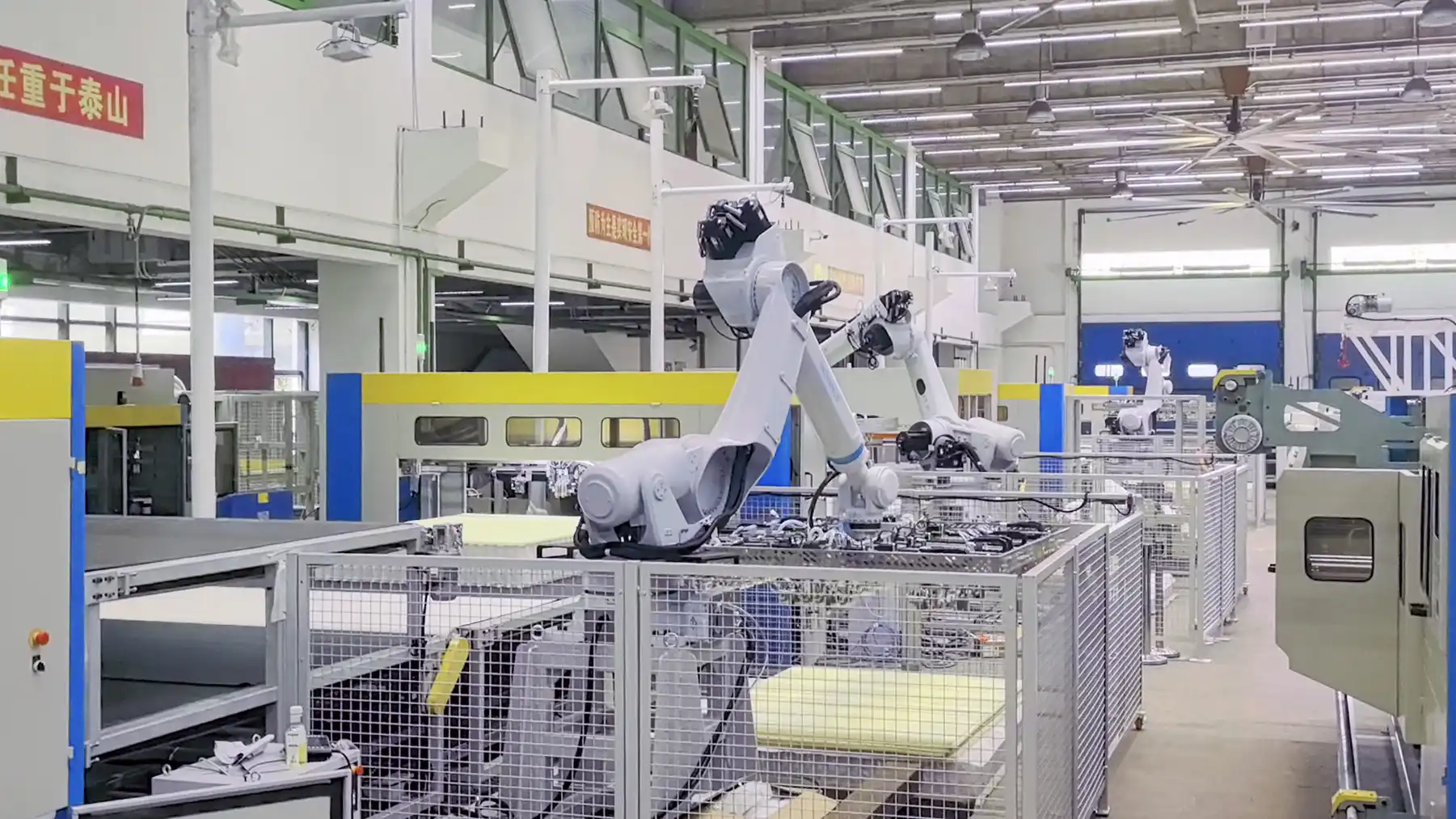
The production line connects the major mattress assembly processes in a defined sequence:
Pocket Spring Unit Feeding → PUR Glue Spraying → AI Vision Recognition → Robotic Loading → Mattress Layer Assembly → Automatic Flipping → Flat Pressing → Transfer → Intelligent Stacking
The production process begins with the automatic feeding and positioning of mattress components. The PUR glue spraying station applies adhesive according to the programmed bonding requirements. The AI visual system then identifies the actual position and orientation of materials and provides positioning information to the robotic system.
The six-axis robot performs loading and transfer operations, while flexible gripping technology allows it to handle different mattress materials. Where the mattress structure requires turning during assembly, the automatic flipping machine completes the operation before the product enters the pressing stage.
Finally, the mattress is transferred to the intelligent stacking system for organized handling and storage.
The purpose of this architecture is to remove unnecessary manual transfer between individual production processes and create a more stable production rhythm.
The PUR Glue Spraying Machine is responsible for accurately applying adhesive during mattress layer assembly.
Manual glue application can produce variations in spraying position and adhesive quantity. For a mattress factory operating at high volume, even small variations can increase glue consumption and affect production consistency.
LianRou’s intelligent PUR spraying system combines precision spraying with controllable glue quantity. Manufacturers can adjust the amount of adhesive according to the mattress structure and bonding requirements instead of applying a fixed amount manually.
The system is designed to provide accurate spraying, consistent adhesive distribution and reliable bonding. According to LianRou’s production data, the intelligent spraying process can reduce adhesive consumption by 30–40% or more, depending on mattress design and operating conditions.
For high-output manufacturers, adhesive efficiency is particularly important because glue consumption becomes a recurring production cost. Precision application therefore contributes not only to bonding consistency but also to overall manufacturing economics.
The AI Visual Intelligent Feeding System addresses the positioning problem created by flexible mattress materials.
Unlike rigid industrial components, foam, latex and other mattress layers can move or become slightly misaligned during conveying. A robot following a completely fixed path may therefore require highly controlled upstream positioning.
LianRou’s AI visual system analyzes the material image in real time and identifies its coordinates and offset angle. This information is transferred to the robot control system, allowing the six-axis robot to adjust its movement according to the actual material position.
The system can achieve positioning accuracy of up to ±3 mm under specified production conditions.
This approach makes automated mattress assembly more flexible because the robot does not have to rely entirely on a predetermined material position. Instead, the production system can recognize variation and compensate for it before handling or placement.
For mattress factories producing different sizes or structures, this flexibility is particularly useful when multiple product specifications need to share the same automated production environment.
The Composite Robot and Loading and Unloading Robot perform the repetitive material-handling operations required between mattress production stations.
The robotic system can work with flexible materials including foam, latex, coconut coir boards and other mattress filling or comfort-layer materials. Its adaptive non-marking gripping technology is designed to pick up and transfer materials while reducing the risk of surface damage.
Instead of assigning workers to repeatedly lift and move materials, the robot can perform loading, unloading and transfer operations according to the programmed production sequence.
This is particularly valuable in high-volume mattress production because material handling can otherwise become a hidden bottleneck. Even when the gluing or pressing equipment has sufficient capacity, workers may not be able to maintain the same rhythm throughout an extended production shift.
Automated handling creates a more predictable connection between workstations and allows human workers to move away from repetitive physical operations toward equipment supervision, quality control and production management.
Some mattress structures require the product to be turned during multi-layer assembly. Manual mattress turning is physically demanding and can interrupt an otherwise automated production process.
LianRou’s Automatic Mattress Flipping Machine, also known as a Mattress Turning Machine or Mattress Turnover Machine, uses a full-servo flexible flipping mechanism to automatically rotate mattresses during production.
The servo-driven system is designed to provide controlled and stable movement while accommodating different mattress structures and assembly sequences.
Its main function is to eliminate a manual turning step from the production flow. This allows mattress assembly to continue through the required sequence without relying on workers to repeatedly lift and rotate mattresses.
For a fully automated mattress production line, removing this type of manual bottleneck is important because automation is only effective when the individual processes can maintain a compatible production rhythm.
After the mattress layers have been positioned and bonded, the Mattress Foam and Latex Flat Press Machine performs the pressing stage.
This equipment is also described as a Mattress Foam and Latex Platen Press in mattress manufacturing applications. Its purpose is to apply controlled pressure to the assembled mattress layers so that the structure becomes compact and stable after bonding.
This stage is particularly relevant to mattresses combining pocket springs with foam, latex, coconut coir or other comfort materials because different layers must remain correctly positioned during final assembly.
By integrating the flat press into the automated production line, the mattress can move directly from robotic assembly to pressing without requiring workers to manually transport and position the product.
The result is a more consistent final assembly process and a cleaner connection between material placement, bonding and finished mattress handling.
A mattress factory does not necessarily need the same automation configuration as another factory. Production volume, mattress specifications, factory space and existing equipment all affect the appropriate line design.
LianRou therefore uses a modular production concept. Manufacturers can configure the number of PUR glue spraying stations, AI visual feeding systems, robotic units, flipping modules, pressing stations and conveying sections according to their requirements.
For higher-volume production, multiple workstations can operate in parallel. This allows manufacturers to increase throughput without redesigning the entire production concept.
The modular structure is also suitable for factories upgrading existing equipment. Instead of replacing every machine at once, manufacturers can plan automation around their current production process and expand the system as demand increases.
The objective is to create a production line that matches the factory’s actual capacity rather than forcing every manufacturer into a fixed configuration.
The key production specifications of the LianRou AI vision mattress production line include:
Parameter | Specification |
Production mode | Fully automatic |
Daily capacity | 1,500+ mattresses/day* |
Operation | 24-hour continuous production |
Potential labor saving | Up to 8 workers |
AI positioning accuracy | Up to ±3 mm |
Adhesive technology | Intelligent PUR glue spraying |
Potential glue saving | 30–40%+* |
Robot system | Six-axis robotic handling |
Material handling | Flexible non-marking adaptive gripping |
Production design | Modular and customizable |
*Actual capacity and adhesive consumption depend on mattress dimensions, structure, production configuration and operating conditions.
For procurement purposes, these figures should be evaluated together rather than separately. A mattress factory’s actual output depends on the balance between gluing, feeding, robotic handling, flipping, pressing, conveying and stacking.
The first consideration is the factory’s actual production requirement. Buyers should define daily output, mattress dimensions, product structures and the number of mattress models that will share the line.
The second consideration is equipment compatibility. If the factory already operates pocket spring machines or pocket spring gluing machines, the new automation system should be planned around their production rhythm and output.
The third consideration is factory layout. Conveyor direction, material storage, robot working areas, safety zones and finished-product stacking locations all affect the final design.
The fourth consideration is future expansion. A modular production line is more suitable when the manufacturer expects production volume to increase because additional spraying stations or robotic modules can be incorporated into the system.
Finally, buyers should evaluate engineering support beyond the machine itself. Installation, commissioning, operator training, troubleshooting, and long-term technical support are important when purchasing an integrated mattress automation system.
LianRou has specialized in mattress machinery manufacturing since 1998, with 28 years of experience in production and R&D.
The company develops equipment covering pocket spring manufacturing, pocket spring assembly, mattress compression, mattress packaging and automated mattress production solutions. LianRou states that its machinery has served more than 2,000 customers in 150+ countries.
This experience is relevant when purchasing an integrated automation line because the robotic system must work together with the mattress manufacturing process rather than operate independently.
For manufacturers, the value of working with a mattress machinery specialist is the ability to consider the production process as a whole—from pocket spring production and assembly to gluing, material handling, pressing and final packaging—rather than sourcing unrelated machines from multiple suppliers.
LianRou also provides installation, commissioning, operator training and technical support to help manufacturers bring integrated production systems into operation.
Yes. The line can be designed to connect with existing pocket spring gluing equipment and related upstream mattress machinery. The final configuration should be determined according to the output, dimensions and production rhythm of the existing equipment.
The flexible robotic handling system can be configured to handle materials such as foam, latex and coconut coir boards, as well as pocket spring units and other mattress components.
Yes. The modular architecture allows manufacturers to configure multiple AI visual feeding systems and robotic workstations for parallel production when higher throughput is required.
Yes. Production-line configuration can be designed around the manufacturer's mattress dimensions, structures, production volume and factory layout.
Not necessarily. The modular design can be considered for both new smart mattress factories and upgrades to existing production facilities, subject to available space and equipment compatibility.
In this application, Mattress Turning Machine, Mattress Turnover Machine and Automatic Mattress Flipping Machine refer to the mattress-turning function used during automated assembly.
Yes. The material-handling and flat-pressing systems can be configured for mattress structures incorporating foam, latex and other comfort materials.
Manufacturers should provide mattress dimensions, mattress structures, daily production requirements, existing equipment, available factory space and the desired automation level. This information allows the production-line configuration to be matched to actual manufacturing requirements.
Yes. LianRou provides installation, commissioning, operator training and technical support for its machinery and integrated production solutions.
Yes. The system is designed for continuous automated production and can be configured with multiple parallel workstations. Under suitable configurations, the line can support 1,500+ mattresses per day.


TOP
