A full set of intelligent mattress machinery industry brands
Mattress machines are exported to 150+ countries
Date:2026-08-28
One-Person-One-Mattress (OPOM) represents a complete flexible manufacturing solution whose technical essence lies not in altering mattress firmness but in fundamentally restructuring the entire decision-making chain from "design input" to "production output." The solution employs human body pressure sensors to acquire pressure distribution data across the shoulders, back, lumbar region, pelvis, and legs, converts these data via algorithmic mapping into spring parameters—including height, coil count, wire diameter, and dual-layer structural configuration—and ultimately manufactures a pocket spring mattress core that precisely matches the individual's body contour via dual-layer curvilinear pocket spring production equipment.
In contrast to the conventional mass-production logic of "designing a product first, then matching it to consumers," OPOM adopts a reverse manufacturing logic: acquiring individual biomechanical data first, then determining mattress structural parameters accordingly. The complete technical pathway is:
Pressure Data Acquisition → Biomechanical Modeling → Zoning Algorithm Mapping → Spring Parameter Generation → Dual-Layer Curvilinear Pocket Spring Manufacturing → Mattress Core Assembly → Final Product Delivery
For B2B mattress manufacturers, the core value of this solution lies not in adding a "customization" label, but in establishing a technically viable pathway for transitioning from standardized mass production to data-driven flexible manufacturing.
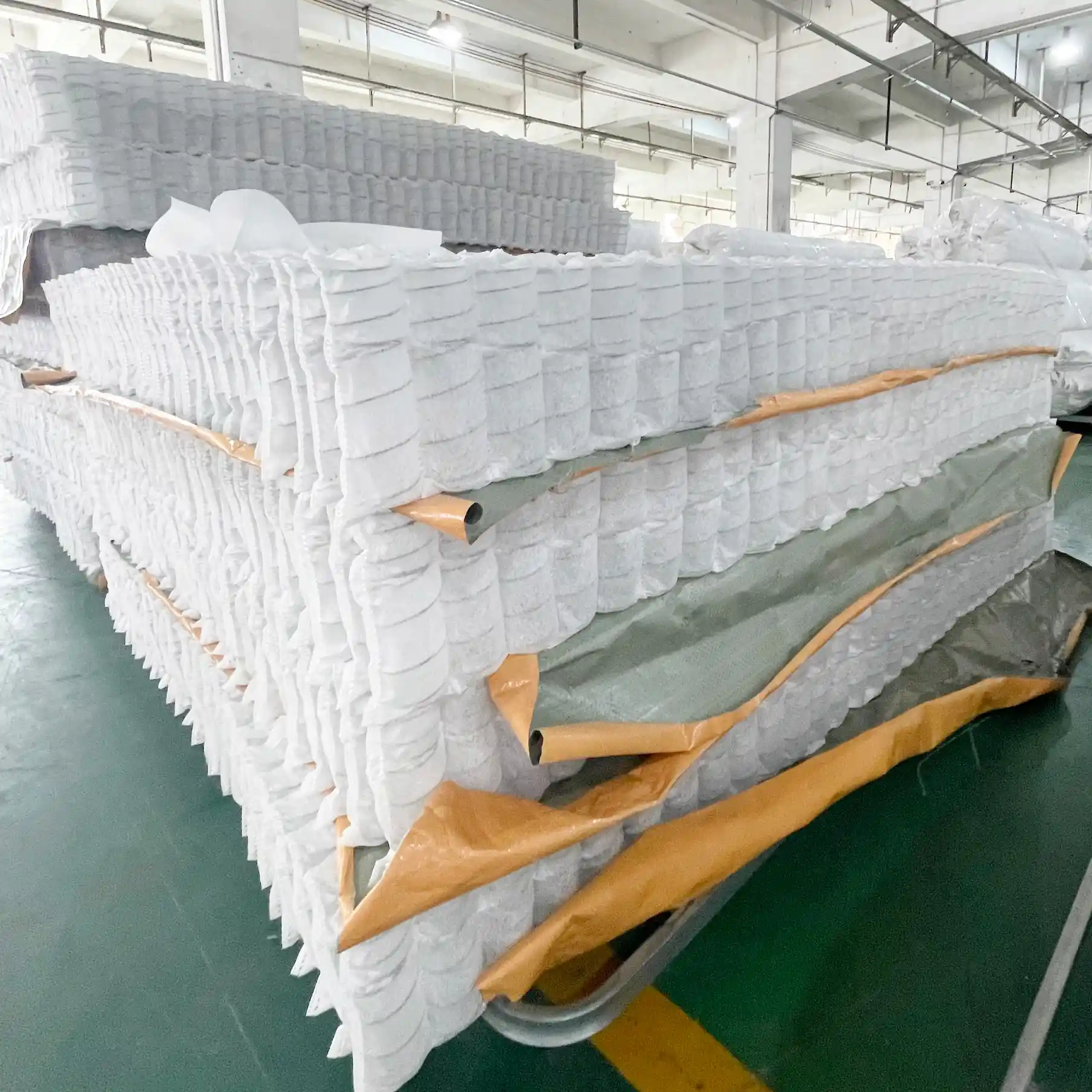
The principal technical bottleneck of conventional spring mattresses is the lack of functional differentiation in support structures. Regardless of whether single-layer, double-layer stacked, or multi-layer spring configurations are employed, the spring system within the mattress plane exhibits homogeneous or fixed-zone arrangement. This design fundamentally treats springs as a "uniform elastic body" rather than a "differentiated response system."
The direct consequence is that the mattress applies undifferentiated support forces to physiologically distinct body regions—shoulders, back, lumbar spine, pelvis, and legs—which have substantially different weight-bearing requirements. For individuals with broader shoulders, standard springs cannot provide sufficient localized pressure relief; for those with lighter lumbar loading, equivalent spring stiffness results in over-support; for individuals with greater pelvic mass, standard springs lack adequate anti-sinking bottom support.
From a biomechanical perspective, this "single spring system responding to all body regions" design logic violates the inherent non-homogeneous pressure distribution characteristics of the human body in recumbent postures. Prolonged use can result in:
·Sustained localized muscle tension at shoulder pressure points, leading to morning soreness;
·Lumbar suspension or excessive pressure, causing the lumbar spine to deviate from its natural physiological curvature;
·Uneven pelvic sinking and tilting, inducing lateral spinal curvature.
A prevalent technical misconception in the industry assumes that increasing the number of spring layers improves support quality. From an engineering analysis perspective, multi-layer springs that lack regionally differentiated parameter design remain essentially planar homogeneous elastic bodies in superposition—while the upper layer's deformation transfers to the lower layer, the stiffness ratio between upper and lower layers remains constant across all regions, failing to generate region-specific stiffness gradients for different body parts.
The genuine technical breakthrough lies not in "increasing layer count" but in whether the spring parameters (height, coil count, wire diameter) within each layer exhibit spatial variation across regions, and whether the stiffness ratios between upper and lower layers vary according to regional requirements.
Conventional seven-zone pocket spring mattresses base their zoning on population statistical averages—determining zone positions and spring stiffness based on statistical medians of shoulder width, pelvic position, and lumbar curvature obtained from large sample measurements. Statistically, this approach represents "estimating population parameters using sample means," resulting in significant support errors for individuals deviating from the mean.
OPOM adopts an individual measured data-driven zoning methodology. A pressure sensor matrix captures each individual's contact pressure distribution in both supine and lateral recumbent postures, constructing a personalized pressure curve. This curve reflects the genuine weight-bearing requirements of each body region for that specific individual, rather than statistical estimates.
The system segments the body into functional regions based on three metrics—pressure peak values, pressure gradients, and contact area—and independently calculates the required spring parameters for each region. Zoning is determined not by preset positional templates, but by natural clustering results derived from measured pressure data.
The dual-layer curvilinear pocket spring mattress core serves as the physical execution layer of this technical solution, designed according to the functional division principle:
Upper Layer (Comfort Layer) :
·Function: Body contour conformity, localized peak pressure dispersion, initial deformation response
·Parameter characteristics: Finer wire diameter (typical: 1.0–1.2mm), higher coil count, longer effective length
·Mechanical behavior: Low stiffness, large deformation, non-linear progressive compression
Lower Layer (Support Layer) :
·Function: Deep anti-sinking bottom support, limiting excessive displacement, maintaining neutral spinal alignment
·Parameter characteristics: Thicker wire diameter (typical: 1.4–1.8mm), lower coil count, shorter effective length
·Mechanical behavior: High stiffness, small deformation, linear elastic response
The upper and lower springs operate synergistically through a series stiffness model. During shallow compression, the upper layer dominates deformation, providing soft conformity. During deeper compression, the lower layer progressively engages, delivering gradually increasing support force. This progressive stiffness curve creates a continuous mechanical transition from soft to firm support, distinct from the linear or step-change stiffness characteristics of conventional springs.
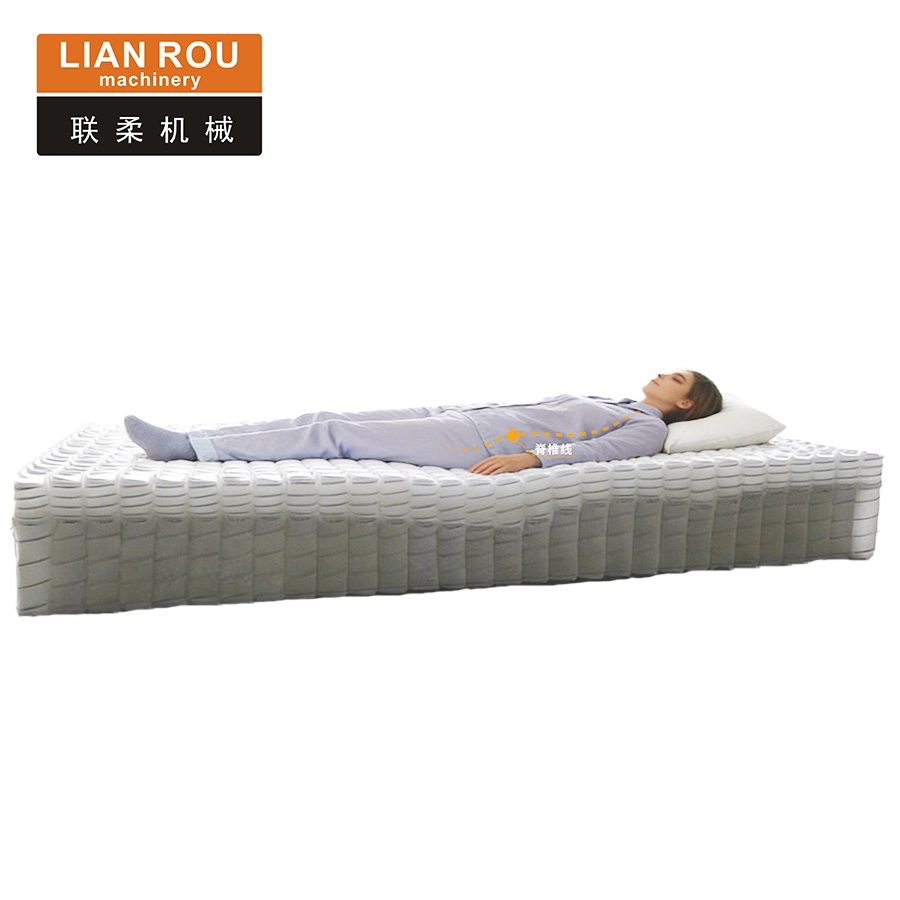
Spring parameters for each body region are algorithmically mapped from the individual pressure curve. The core mapping rules are as follows:
Body Region | Pressure Characteristics | Upper Spring Strategy | Lower Spring Strategy | Comprehensive Mechanical Objective |
Shoulders | Localized high pressure in lateral recumbency | Taller spring, finer wire, higher coil count for enhanced conformity and pressure relief | Moderate stiffness, permitting controlled sinkage | Reduce localized pressure, avoid brachial plexus compression |
Lumbar | Relatively low pressure in supine recumbency, requires avoidance of suspension | Moderate height, controlled deformation | Stable support, providing lumbar load-bearing | Maintain natural lumbar lordosis |
Pelvis | Primary load-bearing zone, high pressure peak | Taller spring, soft conformation, expanded contact area | Thicker wire, shorter spring, anti-sinking bottom support | Disperse pressure, restrict excessive pelvic sinkage |
Legs | Low-pressure zone | Relatively softer parameters | Light support | Ensure unobstructed blood circulation |
The essence of this regionalized design is that the spring mattress core is no longer a single elastic body but an elastic matrix with stiffness continuously varying across spatial position.
According to independent test data from MTO Aberdeen Mattress (UK), mattresses incorporating dual-layer curvilinear pocket spring structures achieve a 65% improvement in pressure distribution uniformity across spinal segments in recumbent postures (compared to conventional independent pocket spring mattresses of equivalent thickness and fabric specification).
The engineering implication of this metric: the pressure gradient across the spine from cervical to sacral vertebrae is more gradual, avoiding localized stress concentration. From a biomechanical perspective, this indicates that intervertebral discs experience compression loads closer to physiological equilibrium across segments, reducing degenerative disc risks associated with localized overloading.
Further quantification: morning muscle soreness is reduced by 58%. The physiological basis of muscle soreness is sustained compensatory contraction of certain muscle groups during sleep due to insufficient mattress support, resulting in lactic acid accumulation. Improved pressure distribution uniformity directly reduces the requirement for compensatory muscle contraction.
Sleep monitoring data from MTO Dunns Mattress (UK) demonstrate that the dual-layer curvilinear pocket spring structure achieves:
·42-minute extension of deep sleep (NREM Stage 3) duration per night
·37% reduction in nocturnal turning frequency
The correlation between extended deep sleep duration and reduced turning frequency has a mechanical basis: one trigger mechanism for turning behavior is the body movement reflex initiated when surface pressure exceeds a certain threshold. The dual-layer curvilinear structure, through regionally differentiated support, reduces localized pressure peaks, thereby delaying the triggering of body movement reflexes and reducing unnecessary arousal responses.
From a clinical biomechanical perspective, the dual-layer curvilinear pocket spring mattress can be classified as a corrective mattress. Its corrective mechanism does not involve actively "pushing" the spine into alignment, but rather eliminates passive compensatory postures caused by imbalanced support forces, allowing the skeleton to return to neutral alignment under natural gravitational forces.
Specifically:
·The lumbar region receives appropriate support, preventing excessive lumbar kyphosis or lordosis;
·The pelvis receives stable support in the pelvic region, preventing lateral tilting or rotation;
·The shoulders in lateral recumbency achieve sufficient sinkage space, preventing cervical lateral flexion.
Regardless of supine, lateral, or prone positions, the regionally differentiated spring responses ensure that all body parts and internal organs (heart, lungs, gastrointestinal tract, blood vessels) remain in a low-pressure or pressure-free state—blood circulation is not mechanically obstructed, and nerve conduction is not compromised by compression. This technical feature distinguishes it from conventional mattresses that merely address "firmness," positioning it within the technical domain of ergonomic corrective devices.
Technical Dimension | Conventional Pocket Springs (Single/Multi-Layer Stacked) | Dual-Layer Curvilinear Pocket Springs |
Spatial Distribution of Spring Parameters | Uniform or fixed-zone | Continuously varying by region |
Upper-Lower Layer Functional Relationship | Homogeneous stacking, no functional differentiation | Upper comfort + lower support, complementary functions |
Stiffness Curve Characteristics | Linear or step-change | Progressive continuous curve |
Response to Body Regions | Undifferentiated support | Differentiated zonal response |
Spinal Pressure Distribution | Localized stress concentration | 65% uniformity improvement (measured) |
Corrective Function | None | Achieved through eliminating compensatory postures |
Design Basis | Population statistical means | Individual measured pressure data |
Technical Conclusion: No matter how advanced or expensive a conventional-structure mattress may be—including multiple comfort layers, high-density foam padding, etc.—it cannot achieve regionally differentiated progressive stiffness curves at the spring layer, because its underlying mechanical architecture lacks spatial parameter adjustability. Comfort materials (memory foam, latex, etc.) can provide some degree of surface-level pressure dispersion, but cannot substitute for the zonal bottom support function of the spring layer—surface material deformation is constrained by thickness and material non-linearity, and cannot deliver deep, regionally differentiated anti-sinking support.
This is precisely the technical reason why dual-layer curvilinear pocket spring mattresses have gained substantial market acceptance in the European premium segment: they compete not on the "comfort feel" of cover materials, but on the "structural support" of the spring layer, establishing a technical barrier.
The technical value of the OPOM solution for mattress manufacturers lies in providing a systematic pathway from standardized batch production to data-driven flexible manufacturing, rather than a single piece of equipment or process improvement.
The complete production system comprises the following modules:
For B2B manufacturers planning to implement this production line, the following technical parameters should be prioritized in equipment selection:
·Spring height automatic adjustment range: Recommended coverage of 80–200mm to accommodate differentiated height requirements across upper and lower functional zone
·Coil count switching capability: Support independent adjustment of 4–10 coils per spring unit
·Wire diameter compatibility range: Minimum coverage of 1.0–1.8mm
·Zonal switching response time: Parameter switching time per spring unit ≤0.5s to maintain production efficiency
·Data interface protocols: Compatibility with mainstream MES systems and pressure data analysis software
A three-phase implementation approach is recommended:
Phase 1: Establish pressure testing and data analysis unit, develop 2–3 standardized zonal templates to validate market demand
Phase 2: Deploy a single dual-layer curvilinear spring production line for small-batch customized production, building parameter mapping expertise
Phase 3: Fully automated closed-loop integration—"pressure testing → parameter generation → equipment execution"—enabling scalable customization
The technical essence of the One-Person-One-Mattress dual-layer curvilinear pocket spring mattress is twofold: replacing population statistical means with individual biomechanical data as the mattress design input, and replacing planar homogeneous elastic bodies with spatially differentiated spring parameters as the mattress support structure.
·Quantified technical advantages of this solution:
·65% improvement in spinal pressure distribution uniformity
·58% reduction in morning muscle soreness
·42-minute/night extension of deep sleep duration
·37% reduction in nocturnal turning frequency
For B2B mattress manufacturers, the significance of this solution transcends single-product innovation—it represents a technical transition pathway from mass manufacturing to data-driven flexible manufacturing, enabling manufacturers to evolve from "producing standard mattresses" to "providing personalized sleep support system solutions," establishing differentiated technical barriers in premium segments including high-end customization, corrective mattresses, and rehabilitation-oriented sleep products.


TOP
